


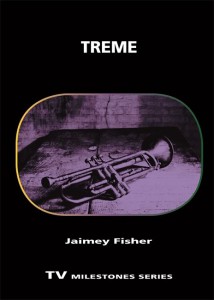
Treme


 (0 vote)
Moyenne des votes :
| 0 | vote |  = On peut s'en passer = On peut s'en passer |
| 0 | vote |  = Bon livre = Bon livre |
| 0 | vote |  = Excellent livre = Excellent livre |
| 0 | vote |  = Unique / une référence = Unique / une référence |
Votre vote : -
Description de l'ouvrage:
Explores the urban context of post-Katrina New Orleans with which the TV show engages.
In Treme, Jaimey Fisher analyzes how the HBO television series Treme (2010–13) treads new ground by engaging with historical events and their traumatic aftermaths, in particular with Hurricane Katrina in 2005 and subsequent flooding in New Orleans. Instead of building up to a devastating occurrence, David Simon's much anticipated follow-up to The Wire (2002-08) unfolds with characters coping in the wake of catastrophe, in a mode that Fisher explores as "afterness." Treme charts these changes while also memorializing the number of New Orleans cultures that were immediately endangered.
David Simon's and Eric Overmyer's Treme attempts something unprecedented for a multi-season series. Although the show follows, in some ways, in the celebrated footsteps of The Wire—for example, in its elegiac tracking of the historical struggles of an American city—Fisher investigates how Treme varies from The Wire's work with genre and what replaces it: The Wire is a careful, even baroque variation on the police drama, while Treme dispenses with genre altogether. This poses considerable challenges for popular television, which Simon and Overmyer address in several ways, including by offering a carefully montaged map of New Orleans and foregrounding the distance witnessing of watershed events there. Another way in which Treme sets itself apart is its memorialization of the city's inestimable contributions to American music, especially to jazz, soul, rhythm and blues, rap, rock, and funk. Treme gives such music and its many makers unprecedented attention, both in terms of screen time for music and narrative exposition around musicians. A key element of the volume is its look at the show's themes of race, crime, and civil rights as well as the corporate versus community recovery and remaking of the city.
Treme's synthesizing mélange of the arts in their specific geographical context, coupled with political and socio-economic analysis of the city, highlights the show's unique approach. Fans of the works of Simon and Overmyer, as well as television studies students and scholars, will enjoy this keen-eyed approach to a beloved show.
À propos de l'auteur :
Jaimey Fisher is professor of German and cinema and digital media and director of the UC Davis Humanities Institute at the University of California, Davis. He is the author of Christian Petzold and Disciplining Germany: Youth, Reeducation, and Reconstruction after the Second World War (Wayne State University Press, 2007). He edited the volume Generic Histories of German Cinema: Genre and its Deviations and has also co-edited The Berlin School and its Global Contexts: A Transnational Art Cinema (Wayne State University Press, 2018), among other edited volumes.
Revue de Presse:
Finished Jaimey Fisher's invigorating TV Milestone on Treme. The book offers great context for thinking about series in conjunction with all the other "quality TV" of the 2010s. Fisher uses Treme to explore how New Orleans was reshaped culturally and spatially by "disaster capitalism" and notes that it is one of the few shows to depict effects of neoliberal policy. Fisher's book also excels in celebrating how Simon sought to craft a new form of TV that celebrates and mourns New Orleans.
-Brian Faucette
Although it didn't find a very large or long-lasting audience when it originally aired, Treme is a show of great sociological, political, cultural, historical, and aesthetic interest, and it is sure to be watched, studied, and written about for years to come. This book presents a large amount of sociopolitical background and artistic analysis that both scholarly and general viewers should find valuable. It is especially worthwhile in such areas as the show's treatments of music and food and in its discussions of 'distance-witnessing' and 'afterness.'
-David Sterritt, Author of the Honeymooners (Wayne State University Press, 2009)
The book deftly weaves together discussion of the musical heritages and generational tensions explored in the series with the personal histories of several of the characters, which are based on actual persons. It's clear that Fisher has a genuine knowledge and appreciation of the aesthetic distinctiveness of New Orleans and the series Treme.
-Robert Burgoyne, Author of the Hollywood Historical Film and Film Nation: Hollywood Looks at U.s. History
Voir le site internet de l'éditeur Wayne State University Press
Voir la fiche de Treme (TV Series) (2010–2013) sur le site IMDB ...
> Du même auteur :
New German Cinema and Its Global Contexts (2025)
A Transnational Art Cinema
Dir. Marco Abel et Jaimey Fisher

Christian Petzold (2023)
Interviews
Dir. Marco Abel, Aylin Bademsoy et Jaimey Fisher
Sujet : Director > Christian Petzold

German Ways of War (2022)
The Affective Geographies and Generic Transformations of German War Films
The Berlin School and Its Global Contexts (2018)
A Transnational Art Cinema
Dir. Jaimey Fisher et Marco Abel

The Collapse of the Conventional (2010)
German Film and Its Politics at the Turn of the Twenty-First Century
Dir. Brad Prager et Jaimey Fisher
> Sur un thème proche :
A Place Both Wonderful and Strange (2026)
The Extraordinary Untold History of Twin Peaks
de Scott Meslow
Sujet : One Film > Twin Peaks (TV Series)

SpongeBob SquarePants (2026)
The Art of an Undersea World
Sujet : One Film > SpongeBob SquarePants (TV Series)



Stranger Things (2026)
The Complete Scripts, Season 5
Collectif
Sujet : One Film > Stranger Things (TV Series)
Next Time on Dragon Ball (2026)
Playing with a Manga and Anime Franchise
Sujet : One Film > Dragon Ball (TV Series)
Shooting Columbo (2025)
The Lives and Deaths of TV's Rumpled Detective
de David Koenig
Sujet : One Film > Columbo (TV Series)

Theology, Religion, and The Office (2025)
Beauty in Ordinary Things
Dir. Daniel J. Cameron
Sujet : One Film > The Office (TV Series)
 Retour

