


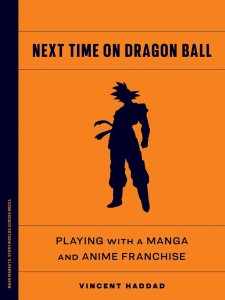
Next Time on Dragon Ball
Playing with a Manga and Anime Franchise


 (0 vote)
Average rating:
| 0 | rating |  = We can do without = We can do without |
| 0 | rating |  = Good book = Good book |
| 0 | rating |  = Excellent book = Excellent book |
| 0 | rating |  = Unique / a reference = Unique / a reference |
Your rating: -
Book Presentation:
How media production and fan play interact to shape the aesthetics of a global anime franchise
Since its debut in 1984, Dragon Ball has become one of the most popular, influential, and lucrative media franchises in the world. In Next Time on Dragon Ball, Vincent Haddad investigates how the franchise has maintained huge global demand despite its formulaic plotlines. Examining its exhaustive repetition of storytelling forms across comics, TV series, games, and merchandise, Haddad argues that the convergence of play, fandom, and narrative made Dragon Ball an unlikely success―and a harbinger of broader shifts in the media landscape of franchises from the 1980s to the present.
Haddad conceives of Dragon Ball as a “franchise toy,” a corporate media property that is constantly remixed by its fans in ways that its owners resist but also ultimately embrace: appropriation is essential to the franchise’s popularity. Over the past forty years, Haddad argues, Dragon Ball’s deployment of familiar tropes, cultural references, and narrative forms―from classical Chinese stories and the films of Bruce Lee and Jackie Chan to American franchises like Superman and Star Wars―has invited unique transcultural play. Through diverse examples of how fans use its characters as “playthings,” Haddad shows how Dragon Ball travels across international networked fandoms, highlighting the queer, gendered, and racialized dimensions of this play.
Parsing the dynamics of “sites of conflict” between authorized media and fan content, Next Time on Dragon Ball illuminates how fan engagement across the Americas changes the parameters of what a manga and anime franchise is and can be.
Retail e-book files for this title are screen-reader friendly with images accompanied by short alt text and/or extended descriptions.
About the Author:
Vincent Haddad is associate professor of English at Central State University. He is author of The Detroit Genre: Race, Dispossession, and Resilience in American Literature and Film, 1967–2023.
Press Reviews:
"Vincent Haddad’s study of Dragon Ball’s global circulation will become a foundational work for transnational media studies. But at times it’s possible to forget how much painstaking research and quirky theorizing went into this book because it’s so damn entertaining. Next Time on Dragon Ball feels like a (hugely knowledgeable) fan talking to other fans, and it will appeal to academic and popular audiences alike." ―Andrew Hoberek, author of Considering Watchmen: Poetics, Property, Politics
"Next Time on Dragon Ball takes stock of the complexities and interdependencies of the Dragon Ball series, exploring theories of play, ‘transculturation,’ the ways fans interact with the original material, and how a series originally targeted at children has become popular to the point of obsession among adults. With close readings of presentations of gender, sexuality, and race, Vincent Haddad offers an impressive, exemplary work of cultural criticism and analysis." ―Steven Shaviro, author of Fluid Futures: Science Fiction and Potentiality
See the publisher website: University of Minnesota Press
See Dragon Ball (TV Series) (1986-1989) on IMDB ...
> On a related topic:

What Would Velma Do? (2023)
Life Lessons from the Brains (and Heart) of Mystery, Inc.
Subject: One Film > Scooby-Doo Where Are You? (TV Series)
Race and the Animated Bodyscape (2023)
Constructing and Ascribing a Racialized Asian Identity in Avatar and Korra
Subject: One Film > Avatar: The Last Airbender (TV Series)
How He-Man Mastered the Universe (2017)
Toy to Television to the Big Screen
Subject: One Film > He-Man and the Masters of the Universe (TV Series)

He-Man and the Masters of the Universe (2017)
A Character Guide and World Compendium
Collective
Subject: One Film > He-Man and the Masters of the Universe (TV Series)

He-Man and She-Ra (2016)
A Complete Guide to the Classic Animated Adventures
by James Eatock
Subject: One Film > He-Man and the Masters of the Universe (TV Series)

When Magoo Flew (2012)
The Rise and Fall of Animation Studio UPA
by Adam Abraham
Subject: One Film > Mister Magoo (TV Series)
More Than Meets the Eye (2018)
Special Effects and the Fantastic Transmedia Franchise
by Bob Rehak
Subject: Genre > Science Fiction
 Back
Back

