

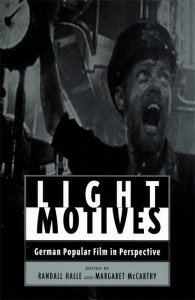
Light Motives
German Popular Film in Perspective
Edited by Margaret McCarthy and Randall Halle


 (0 vote)
Average rating:
| 0 | rating |  = We can do without = We can do without |
| 0 | rating |  = Good book = Good book |
| 0 | rating |  = Excellent book = Excellent book |
| 0 | rating |  = Unique / a reference = Unique / a reference |
Your rating: -
Book Presentation:
Light Motives undertakes a long overdue critical reassessment of German popular cinema, challenging the traditional view of German film history and offering new ways to think about popular cinema in general.
Critics rarely associate popular film with German cinema, despite the international success of such films as Das Boot (1981), The Never-Ending Story (1984), Run, Lola, Run (1998), and recent German comedies, all representing a rich body of work outside the parameters of high culture. This very success compels the authors of Light Motives to take an unprecedented look at German popular film across the historical spectrum and to challenge the tendency among critics to divvy up German film, like Germans themselves, into the Good and the Bad. Together the essays reexamine popular film production along with larger cultural, historical, and political meanings suggested by the term "popular."
Most critical accounts have focused on the golden era of Weimar film and the New German Cinema of the 1960s and 70s leaving much of popular film by the wayside. This volume attributes the division to such sources as Frankfurt School dictates, Goethe Haus film offerings, and state-funded film production during the 1970s, which promoted high-culture art films to broadcast the success of West German democratization.
The essays challenge the traditional shape of German film history, while offering in-depth analyses of films that have until now been beyond the pale of critical attention. What emerges is a "Never-Ending Story" of oft-repeated obsessions, overlapping generic forms, omnipresent or subtle nods to Hollywood, and myriad political concerns irreducible to a unified message or aesthetic form—all bearing witness to the vibrancy of German culture.
About the authors:
Randall Norman Halle is an assistant professor of German Studies and Film Studies at the University of Rochester.Margaret R. McCarthy is an assistant professor at Davidson College.
Press Reviews:
German filmmaking has always been interesting, sometimes difficult and sometimes innovative. This collection demonstrates that history and tradition and illustrates how it goes on today. The range of voices reflects the range of perspectives German cinema offers, while the depth of scholarship should satisfy the most critical connoisseur. Yet this is not just a collection for specialists. It should claim the attention of anyone interested in the creative tension between culturally-specific, national film industries and today's globalised media culture.
-Stan Jones
Abandon any preconceived notion that popular cinema is escapist, unpolitical, naive, kitschy, big-budget, propagandistic, or for the uneducated! Forget equating German cinema with Teutonic demonism or morose self-introspection! This superb collection sweeps away tiresome cliches with path-breaking, sophisticated analyses of films from 1919 to the present, including contributions on the much neglected cinema of the 1950s and 1960s.
-Alice Kuzniar
Light Motives makes an important contribution to the reassessment of German cinema from the perspective of popular genres, visual pleasures, and mass cultural practices. Informed by cultural studies, individual readings move beyond the old divisions among art cinema, escapist entertainment, and film propaganda and present us with a very different national cinema and, by extension, film history. Very stimulating!
-Sabine Hake, Author of Popular Cinema of the Third Reich and German National Cinema
> From the same authors:

Mad Mädchen (2019)
Feminism and Generational Conflict in Recent German Literature and Film
German Film after Germany (2008)
Toward a Transnational Aesthetic
> On a related topic:
German Popular Cinema and the Rialto Krimi Phenomenon (2023)
Dark Eyes of London
New German Cinema and Its Global Contexts (2025)
A Transnational Art Cinema
Dir. Marco Abel and Jaimey Fisher

Charting Asian German Film History (2025)
Imagination, Collaboration, and Diasporic Representation
Dir. Qinna Qinna Shen, Zach Ramon Fitzpatrick and Qingyang Freya Zhou

Neubau Atmospheres (2025)
East German Cultural Remediations of Modernist Architecture
Transnational German Film at the End of Neoliberalism (2024)
Radical Aesthetics, Radical Politics
Dir. Claudia Breger and Olivia Landry

Cinematically Transmitted Disease (2024)
Eugenics and Film in Weimar and Nazi Germany
 Back
Back