


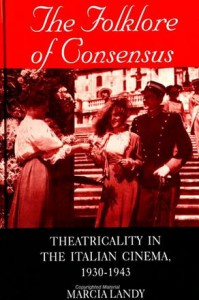
The Folklore of Consensus
Theatricality in the Italian Cinema, 1930-1943
by Marcia Landy


 (0 vote)
Average rating:
| 0 | rating |  = We can do without = We can do without |
| 0 | rating |  = Good book = Good book |
| 0 | rating |  = Excellent book = Excellent book |
| 0 | rating |  = Unique / a reference = Unique / a reference |
Your rating: -
Book Presentation:
Examines the Italian popular cinema's preoccupation with theatricality in the 1930s and early 1940s, arguing that theatricality was a form of politics--a politics of style.
Marcia Landy's The Folklore of Consensus examines the theatricality in the Italian popular cinema of the 1930s and early 1940s, arguing that theatricality was a form of politics—a politics of style. While film critics no longer regard the commercial films of the era as mere propaganda, they continue to regard the cinema under fascism as "escapist," diverting audiences from the harsh realities of life under fascism. The Folklore of Consensus problematizes the notion of "escapism," examining the complexity that redeems the films from frivolity and evasion. It shifts the focus from a preoccupation with cinema as the public and spectacular purveyor of "fascinating fascism" to a more immediate and intimate terrain that bears on formulations about the role of mass culture then and now.
About the Author:
Marcia Landy is Professor of English/Film Studies at the University of Pittsburgh. She is the author of several books, including most recently Cinematic Uses of the Past; Film, Politics, and Gramsci; and Imitations of Life: A Reader on Film and Television Melodrama.
Press Reviews:
"As with everything Marcia Landy writes, this book is clear, well researched, and well written. It is full of extremely interesting material that is always both informed by theoretical perspectives as well as concrete and based upon close viewings of the works of art in question. Italy's cinema under the fascist government is a fascinating topic for research that has, in part thanks to Landy, begun to attract more serious attention than ever before. Her examination of the various genres employed by this cinema, as well as her desire to go beyond conventional generic considerations of melodrama as film genre and to view it as a conduit for an affect, are original contributions to the literature on the subject.
"Precisely because Landy's work makes it possible to discuss Italian prewar cinema in terms that have relevance to the conventional Hollywood cinema as well, I believe that even film scholars outside the Italian field will find this book very useful, since it makes two kinds of contributions: it sets up an interesting theoretical methodology to speak of certain universal topics that have application to the Hollywood model; and it therefore immediately makes an exploration of the specifically Italian works a far more interesting proposition than people had generally realized before this book." — Peter Bondanella, Indiana University
"I know of no other historian who has found theatricality, role-playing, performance, and spectacle to be such a widespread feature of these films, and Landy's demonstration of this extensiveness is quite convincing. She uses this practice to describe the display of power in Fascist Italy by proposing that these films are more or less about social subjects who engage their worlds through performance and that these films therefore offer a useful and often neglected way of understanding the formation of social (particularly gender) identity in Fascist Italy." — James Hay, University of Illinois
See the publisher website: State University of New York Press
> From the same author:


The Historical Film (2000)
History and Memory in Media
Dir. Marcia Landy
Subject: Genre > Historical films

> On a related topic:
Mussolini's Dream Factory (2015)
Film Stardom in Fascist Italy
Schooling in Modernity (2014)
The Politics of Sponsored Films in Postwar Italy
Traveling Auteurs (2024)
The Geopolitics of Postwar Italian Cinema
Cinema Is the Strongest Weapon (2023)
Race-Making and Resistance in Fascist Italy
Pasta, Pizza and Propaganda (2022)
A Political History of Italian Food TV
Italy through the Red Lens (2021)
Italian Politics and Society in Communist Propaganda Films (1946–79)
Italian Political Cinema (2016)
Public Life, Imaginary, and Identity in Contemporary Italian Film
Dir. Giancarlo Lombardi and Christian Uva
Vital Crises in Italian Cinema (2013)
Iconography, Stylistics, Politics
 Back
Back

