

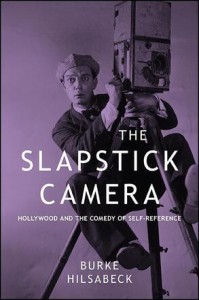
The Slapstick Camera
Hollywood and the Comedy of Self-Reference


 (0 vote)
Average rating:
| 0 | rating |  = We can do without = We can do without |
| 0 | rating |  = Good book = Good book |
| 0 | rating |  = Excellent book = Excellent book |
| 0 | rating |  = Unique / a reference = Unique / a reference |
Your rating: -
Book Presentation:
Demonstrates that slapstick film comedies display a canny and sometimes profound understanding of their medium.
Slapstick film comedy may be grounded in idiocy and failure, but the genre is far more sophisticated than it initially appears. In this book, Burke Hilsabeck suggests that slapstick is often animated by a philosophical impulse to understand the cinema. He looks closely at movies and gags that represent the conditions and conventions of cinema production and demonstrates that film comedians display a canny and sometimes profound understanding of their medium—from Buster Keaton's encounter with the film screen in Sherlock Jr. (1924) to Harpo Marx's lip-sync turn with a phonograph in Monkey Business (1931) to Jerry Lewis's film-on-film performance in The Errand Boy (1961). The Slapstick Camera follows the observation of philosopher Stanley Cavell that self-reference is one way in which "film exists in a state of philosophy." By moving historically across the studio era, the book looks at a series of comedies that play with the changing technologies and economic practices behind film production and describes how comedians offered their own understanding of the nature of film and filmmaking. Hilsabeck locates the hidden intricacies of Hollywood cinema in a place where one might least expect them—the clowns, idiots, and scoundrels of slapstick comedy.
About the Author:
Burke Hilsabeck is Assistant Professor of English at the University of Northern Colorado.
Press Reviews:
"…the book is an edifying contribution to the scholarship on classic Hollywood film." — CHOICE
"From its analysis of the vaudevillian Victorian origins to early Hollywood expressions, and from defining classical performances by the likes of Keaton to recent postmodern recapitulations, Hilsabeck's theoretically rigorous and wide-ranging study masterfully weaves a path through the historical, technical, and philosophical art of slapstick comedy. A must for scholars working in this field." — Daniel Varndell, author of Hollywood Remakes, Deleuze and the Grandfather Paradox
See the publisher website: State University of New York Press
> On a related topic:
The Comedy of Philosophy (2008)
Sense and Nonsense in Early Cinematic Slapstick
by Lisa Trahair
Subject: Silent Cinema
The Films of Mack Sennett (1998)
Credit Documentation from the Mack Sennett Collection at the Margaret Herrick Library
Subject: Others persons > Mack Sennett
 Back
Back