

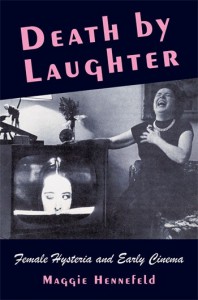
Death by Laughter
Female Hysteria and Early Cinema


 (0 vote)
Moyenne des votes :
| 0 | vote |  = On peut s'en passer = On peut s'en passer |
| 0 | vote |  = Bon livre = Bon livre |
| 0 | vote |  = Excellent livre = Excellent livre |
| 0 | vote |  = Unique / une référence = Unique / une référence |
Votre vote : -
Description de l'ouvrage:
Can you really die from laughing too hard? Between 1870 and 1920, hundreds of women suffered such a fate—or so a slew of sensationalist obituaries would have us believe. How could laughter be fatal, and what do these reports of women’s risible deaths tell us about the politics of female joy?
Maggie Hennefeld reveals the forgotten histories of “hysterical laughter,” exploring how women’s amusement has been theorized and demonized, suppressed and exploited. In nineteenth-century medicine and culture, hysteria was an ailment that afflicted unruly women on the cusp of emotional or nervous breakdown. Cinema, Hennefeld argues, made it possible for women to laugh outrageously as never before, with irreversible social and political consequences. As female enjoyment became a surefire promise of profitability, alarmist tales of women laughing themselves to death epitomized the tension between subversive pleasure and its violent repression.
Hennefeld traces the social politics of women’s laughter from the heyday of nineteenth-century sentimentalism to the collective euphoria of early film spectatorship, traversing contagious dancing outbreaks, hysteria photography, madwomen’s cackling, cinematic close-ups, and screenings of slapstick movies in mental asylums. Placing little-known silent films and an archive of remarkable, often unusual texts in conversation with affect theory, comedy studies, and feminist film theory, this book makes a timely case for the power of hysterical laughter to change the world.
À propos de l'auteur :
Maggie Hennefeld is associate professor of cultural studies and comparative literature at the University of Minnesota, Twin Cities. She is the author of Specters of Slapstick and Silent Film Comediennes (Columbia, 2018), co-curator of the silent film collection Cinema’s First Nasty Women (2022), and coeditor of Unwatchable (2019) and Abjection Incorporated: Mediating the Politics of Pleasure and Violence (2020).
Revue de Presse:
A "Most Anticipated" Book of 2024 The Millions
Just about everything in this book is a delight. Writing with ferocious wit and drawing from an extraordinary archive, Hennefeld historicizes the significance of laughter for gendered and racialized bodies in modern media culture. This is what feminist cultural theory and history looks like at its very best. Jennifer M. Bean, editor in chief of Feminist Media Histories: An International Journal
A tour de force of feminist historiography through cinema’s early archive of hysterical laughter! In a time of perpetual carnival, what promise can laughter still hold? Moving us beyond both capitalist gimmick and revolutionary excess, Hennefeld carefully excavates the affective cluster held in tension by a burst of laughter on the brink of death. Anca Parvulescu, author of Laughter: Notes on a Passion
This stunningly original and altogether insightful book had me in stitches. At times, I giggled quietly, and other times, I laughed out loud. But, time and time again, I was left with new and thought-provoking ideas while reading this side-splitting mash-up of film history, feminist theory, and cultural criticism. Matthew Solomon, author of Méliès Boots
Death by Laughter is an astonishing and astonishingly rich plunge into the stormy waters of laughter. Focusing particularly on hysterical laughter in its political dimension, the book presents us with a remarkable amount of fascinating material, including the extremely interesting but almost forgotten archives of early cinema. Hennefeld navigates this material both boldly and carefully, masterfully relating it to our contemporary social, political, and cultural context. Alenka Zupančič, author of What IS Sex?
This book achieves the rare feat of being both enlightening and thoroughly entertaining . . . [Hennefeld's] historical analysis is compelling and revelatory, with the fluidity of her style making light work of the detail whilst gleefully leading us on to the most interesting of conclusions. ithankyouarthur
Explodes with insightful juxtapositions and contagious cachinnations....Highly recommended. Choice
The roller-coaster ride of [Hennefeld’s] expressive prose takes the reader through the gendered cacophony embedded in public discourse, alongside the female spectator of feminist film theory, to an encounter with the speculative allegory of "Madam Medusa," a feminist reveler who frequently stole the show when going to the movies . . . The book beckons towards a recuperation of women’s laughter as an antiauthoritarian feminist politics embedded in media history. Cinéaste
One of the most energisingly wide-ranging and fast-thinking academic books I have read in a long time. Pamela Hutchinson, Silent London
Voir le site internet de l'éditeur Columbia University Press
> Du même auteur :
Abjection Incorporated (2020)
Mediating the Politics of Pleasure and Violence
Dir. Maggie Hennefeld et Nicholas Sammond
Sujet : Sociology
> Sur un thème proche :
The Comedy of Philosophy (2008)
Sense and Nonsense in Early Cinematic Slapstick
de Lisa Trahair
Sujet : Silent Cinema
Lonesome Luke's Lively Life (2025)
Hal Roach, Harold Lloyd and the Rolin Film Co.
Dir. Steve Massa
Sujet : Actor > Harold LLoyd
 Retour