


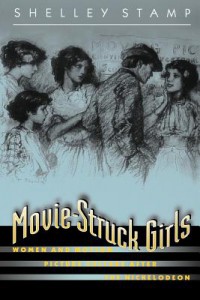
Movie-Struck Girls
Women and Motion Picture Culture After the Nickelodeon


 (0 vote)
Moyenne des votes :
| 0 | vote |  = On peut s'en passer = On peut s'en passer |
| 0 | vote |  = Bon livre = Bon livre |
| 0 | vote |  = Excellent livre = Excellent livre |
| 0 | vote |  = Unique / une référence = Unique / une référence |
Votre vote : -
Description de l'ouvrage:
Movie-Struck Girls examines women's films and filmgoing in the 1910s, a period when female patronage was energetically courted by the industry for the first time. By looking closely at how women were invited to participate in movie culture, the films they were offered, and the visual pleasures they enjoyed, Shelley Stamp demonstrates that women significantly complicated cinemagoing throughout this formative, transitional era. Growing female patronage and increased emphasis on women's subject matter did not necessarily bolster cinema's cultural legitimacy, as many in the industry had hoped, for women were not always enticed to the cinema by dignified, uplifting material, and once there, they were not always seamlessly integrated in the social space of theaters, nor the new optical pleasures of film viewing. In fact, Stamp argues that much about women's films and filmgoing in the postnickelodeon years challenged, rather than served, the industry's drive for greater respectability.
White slave films, action-adventure serial dramas, and women's suffrage photoplays all drew female audiences to the cinema with stories aimed directly at women's interests and with advertising campaigns that specifically targeted female moviegoers. Yet these examples suggest that women's patronage was built with stories focused on sexuality, sensational thrill-seeking, and feminist agitation, topics not normally associated with ladylike gentility. And in each case concerns were raised about women's conduct at cinemas and the viewing habits they enjoyed, demonstrating that women's integration into motion picture culture was not as smooth as many have thought.
À propos de l'auteur :
Shelley Stamp is Assistant Professor of Film and Digital Media at the University of California-Santa Cruz, where she won the Excellence in Teaching Award.
Voir le site internet de l'éditeur Princeton University Press
> Du même auteur :
> Sur un thème proche :
Menus for Movieland (2015)
Newspapers and the Emergence of American Film Culture 1913-1916
de Richard Abel
Sujet : Silent Cinema
The Othering of Women in Silent Film (2023)
Cultural, Historical, and Literary Contexts
Sujet : Silent Cinema
The Silent Feminists (2022)
America's First Women Directors, Rowman & Littlefield Edition
Sujet : Silent Cinema
When Women Wrote Hollywood (2018)
Essays on Female Screenwriters in the Early Film Industry
Dir. Rosanne Welch
Sujet : Silent Cinema
Women in Medicine in Nineteenth-Century American Literature (2018)
From Poisoners to Doctors, Harriet Beecher Stowe to Theda Bara
Sujet : Silent Cinema

Red Velvet Seat (2006)
Women's Writings on the First Fifty Years of Cinema
Dir. Antonia Lant
Sujet : Silent Cinema
A Queer Way of Feeling (2023)
Girl Fans and Personal Archives of Early Hollywood
Sujet : Silent Cinema
 Retour

