


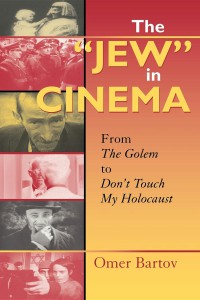
The "Jew" in Cinema
From The Golem to Don't Touch My Holocaust
de Omer Bartov


 (0 vote)
Moyenne des votes :
| 0 | vote |  = On peut s'en passer = On peut s'en passer |
| 0 | vote |  = Bon livre = Bon livre |
| 0 | vote |  = Excellent livre = Excellent livre |
| 0 | vote |  = Unique / une référence = Unique / une référence |
Votre vote : -
Description de l'ouvrage:
From cinema's beginnings, the film image of the "Jew" has closely followed the fortunes and misfortunes of Jews. Analyzing more than 70 films made in the Soviet Union, Poland, Hungary, Czechoslovakia and the Czech Republic, East and West Germany, France, Italy, the United States, and Israel from 1920 to the 1990s, noted historian Omer Bartov argues that depictions of the "Jew" in film have been fed by, or have reacted to, certain stereotypical depictions of Jews arising from age-old prejudices. These images, in turn, both reflected public attitudes and helped to shape them. He points to Mel Gibson's film The Passion of the Christ as one of the most recent examples of the phenomenon. In trenchant discussions of individual films, Bartov develops four basic cinematic representations of the "Jew": as perpetrator (especially in antisemitic films), as victim (especially in films about the Holocaust), as hero (especially in films about the state of Israel), and as anti-hero (especially in films about the Arab-Israeli conflict).
This absorbing book reveals the ways in which powerful images remained deeply embedded in the creative imagination, even as the circumstances that originally engendered them underwent profound changes. Bartov concludes that some of the fundamental prejudices about Jews, which predate cinema, persisted in cinematic depictions throughout the 20th century, although they have been reinterpreted according to changing political regimes, ideologies, and tastes. Covering a range of traditions and periods, The "Jew" in Cinema provides original and provocative interpretations that often contradict conventional views. Placing cinematic representations of the "Jew" within their historical context, Bartov demonstrates the powerful political, social, and cultural impact of these images on popular attitudes.
The Helen and Martin Schwartz Lectures in Jewish Studies
À propos de l'auteur :
Omer Bartov is the John P. Birkelund Distinguished Professor of European History at Brown University. His many books include Hitler's Army, Mirrors of Destruction, and Germany's War and the Holocaust. He lives in Cambridge, Massachusetts.
Revue de Presse:
"In this important work, Omer Bartov examines how the cinematic representations of the 'Jew' as 'perpetrator', 'victim', 'hero' and 'anti-hero' emerge not only throughout the course of film history, but also within a larger cultural practice of stereotyping Jewish identity. His central concern is 'the manner in which the cinematic ''Jew'' reflects the popularization, transformation, resistance to, and reintroduction of anti-Semitic imagery'.Vol. 43, no. 2, 2009"
-Noah Shenker, Ph.D. candidate in Critical Studies at the School of Cinematic Arts,USCLA
"A noted Holocaust scholar, Bartov (history, Brown) has written an extended analytical essay—as distinguished from an encyclopedia study—on the treatment of the figure of the Jew in some 70 European, American, and Israeli motion pictures. He examines these depictions under four separate categories: Jew as perpetrator, victim, hero, and antihero. As the subtitle indicates, the movies studied range chronologically from the 1920 German silent classic The Golem to Don't Touch My Holocaust (1994) and several others produced in Israel and dealing with current Jewish-Arab relations. Most of the films inevitably relate to the Shoah, its origins or aftereffects, and Bartov notes that Gentleman's Agreement (1947) managed to avoid mentioning the Holocaust almost entirely even though it deals with a journalist who posed as a Jew in order to investigate anti-semitism. Bartov's evaluations of individual films are perceptive and often provocative. He calls the television miniseries Holocaust (1978) one of the best cinematic productions ever made on this allegedly unrepresentable event despite its aesthetic limitations and occasional lapses into kitsch, and he is critical of accounts that distort historical reality by focusing on exceptional cases (The Pianist, Schindler's List) because they impede understanding and perpetuate stereotypes. Summing Up: Highly recommended. Upper-division undergraduates through faculty; general readers.July 2005"
-L. D. Stokes, emeritus, Dalhousie University
"Bartov's style is refreshingly free of theoretical jargon and accessible to a wide audience. . . . a rich, deeply historicized, thoughtful, and provocative reading of a wide range of world cinema that grapples with the representation of Jewishness on screen."
-Shofar
> Sur un thème proche :
Jews in Contemporary Visual Entertainment (2022)
Raced, Sexed, and Erased
de Carol Siegel
Sujet : Sociology
Forgiveness and Resentment in the Aftermath of Mass Atrocity (2025)
Jewish Voices in Literature and Film
Sujet : Sociology
Reel Kabbalah (2024)
Jewish Mysticism and Neo-Hasidism in Contemporary Cinema
de Brian Ogren
Sujet : Sociology
Yiddish Cinema (2024)
The Drama of Troubled Communication
de Jonah Corne et Monika Vrečar
Sujet : Sociology

 Retour

