


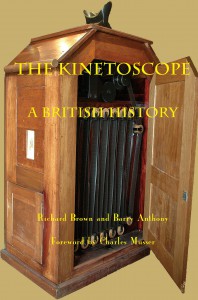
The Kinetoscope
A British History
by Richard Brown and Barry Anthony


 (0 vote)
Average rating:
| 0 | rating |  = We can do without = We can do without |
| 0 | rating |  = Good book = Good book |
| 0 | rating |  = Excellent book = Excellent book |
| 0 | rating |  = Unique / a reference = Unique / a reference |
Your rating: -
Book Presentation:
The 100th anniversary of cinema was marked throughout the world in 1995/6. Amongst the widespread celebrations it was largely overlooked that genuine motion pictures had been commercially shown 101 years earlier, and that the origins of the film industry lay in a peepshow device rather than the more familiar movie projector. Introduced in New York in April 1894 and in Paris and London later in the same year, Thomas Edison's electrically-driven Kinetoscope was the first practical method of film exhibition. Around a thousand of these state-of-the art machines were manufactured, featuring the first brief fiction films and the earliest newsreels. Techniques such as the close-up and stop-editing were introduced and the 35mm film employed became a universal standard. Edison was able to influence the development of the device in the United States, but he soon lost control of the British and European markets. Spearheaded by two entrepreneurial Greek merchants, George Georgiades and George Tragides, a large and often colorful group of showmen began to exploit the new invention. With Edison neglecting to obtain European patents, his agents fought a losing battle to stem an influx of 'bogus' Kinetoscopes onto the market. Leading the construction of replica Kinetoscopes was a young and ambitious electrical engineer who was to become central to the development of world cinema. In his business arrangements with the Greeks Robert William Paul operated close to the limits of legality, a risk-taking attitude that also led him to enter into a partnership with the notorious fraudster and self-publicist 'Viscount' Hinton. The rush to exploit the Kinetoscope faltered when Edison refused to supply films for pirate machines, but regained momentum when Paul and the American Birt Acres constructed their own camera, shooting the first British movies in March/April 1895. The turbulent and often unlikely events of 1894–5 were a crucial prelude to the birth of British cinema.
The position of the Kinetoscope in film history is central and undisputed. An indication of its importance is provided by the detailed attention American scholars have given to examining its history. However, the Kinetoscope's development in Britain has not been well documented and much current information about it is incomplete and out of date. The purpose of the book is, for the first time, to present a comprehensive account, utilizing many previously unpublished sources. The commercial and technical backgrounds of the Kinetoscope are looked at in detail; the style and content of the earliest British films analyzed; and the device's place in the wider world of Victorian popular entertainment examined. A unique legal case is revealed and a number of previously unrecorded film pioneers are identified and discussed. Each of the three authors are recognized specialists in their chosen area of early British film history, and two of them have collaborated previously in a book-length study of a Victorian film company.
About the authors:
Richard Brown is author of The History of the British Mutoscope and Biograph Company and editor of the facsimile edition of W. K-L. Dickson's The Biograph in Battle: Its Story in the South African War.Barry Anthony is author of Murder, Mayhem and Music Hall and contributor to Who's Who of Victorian Cinema; the Encyclopaedia of Early Cinema; and Directors in British and Irish Cinema: A Reference Companion.
> From the same authors:
Finding Birt Acres (2025)
The Rediscovery of a Film Pioneer
by Deac Rossell, Barry Anthony and Peter Domankiewicz
Subject: Silent Cinema
Chaplin's Music Hall (2012)
The Chaplins and their Circle in the Limelight
Subject: Director > Charlie Chaplin
> On a related topic:
The Dream That Kicks (2017)
The Prehistory and Early Years of Cinema in Britain
Subject: Countries > Great Britain
The History of the British Film 1896 - 1906 (2011)
Volume I
Dir. Rachael Low
Subject: Countries > Great Britain
The History of British Film 1906 - 1914 (2011)
Volume II
Dir. Rachael Low
Subject: Countries > Great Britain
The History of the British Film 1914 - 1918 (2011)
Volume III
Dir. Rachael Low
Subject: Countries > Great Britain

The Enchanting Kinora (2025)
Domesticating Moving Images in Edwardian Britain
by Elizabeth Evans and Llewella Chapman
Subject: History of Cinema
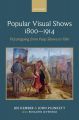
Popular Visual Shows 1800–1914 (2025)
Picturegoing from Peep Shows to Film
by Joe Kember and John Plunkett
Subject: History of Cinema
Politicking and Emergent Media (2016)
US Presidential Elections of the 1890s
Subject: History of Cinema
Flickering Empire (2015)
How Chicago Invented the U.S. Film Industry
by Michael Glover Smith and Adam Selzer
Subject: History of Cinema
 Back
Back

