

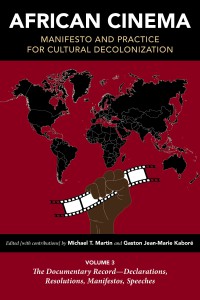
African Cinema
Manifesto and Practice for Cultural Decolonization: Volume 3: The Documentary Record--Declarations, Resolutions, Manifestos, Speeches
Edited by Michael T. Martin and Gaston Jean-Marie Kaboré


 (0 vote)
Average rating:
| 0 | rating |  = We can do without = We can do without |
| 0 | rating |  = Good book = Good book |
| 0 | rating |  = Excellent book = Excellent book |
| 0 | rating |  = Unique / a reference = Unique / a reference |
Your rating: -
Book Presentation:
Challenging established views and assumptions about traditions and practices of filmmaking in the African diaspora, this three-volume set offers readers a researched critique on black film.
Volume Three of this landmark series on African cinema spans the past century and is devoted to the documentation of decoloniality in cultural policy in both Africa and the Black diaspora worldwide. A compendium of formal resolutions, declarations, manifestos, and programmatic statements, it chronologically maps the long history and trajectories of cultural policy in Africa and the Black Atlantic. Beginning with the 1920 declaration of the Rights of the Negro Peoples of the World, which anticipates cinema as we know it today, and the formal oppositional assertions—aspirational and practical. The first part of this work references formal statements that pertain directly to cultural policy and cinematic formations in Africa, while the next part addresses the Black diaspora. Each entry is chronologically ordered to account for when the statement was created, followed by where and in what context it was enunciated.
About the authors:
Michael T. Martin is Professor of Cinema and Media Studies at the Media School at Indiana University, Bloomington. He is editor or coeditor of several anthologies, including (with David C. Wall) The Politics and Poetics of Black Film: Nothing But a Man and Race and the Revolutionary Impulse in The Spook Who Sat by the Door. Martin directed and coproduced the award-winning feature documentary on Nicaragua, In the Absence of Peace, distributed by Third World Newsreel. Gaston Jean-Marie Kaboré is a film director, producer, and screenwriter and the former director of the Centre National du Cinéma in Burkina Faso.
Press Reviews:
"African Cinema: Manifesto and Practice for Cultural Decolonization combines theory and praxis as a means to explore the social, cultural, political, economic and gendered dynamics of African cinemas within a global context, all of which are determining factors in how African filmmaking practitioners and stakeholders negotiate their place as directors, producers, organizers, activists, scholars, distributors, cultural readers. The collection is an important addition to African Cinema Studies in particular, and the library of Film Studies in general."
-Beti Ellerson, Founder and Director, Centre for the Study and Research of African Women in Cinema
"Setting out, African Cinema positioned itself at the intersection of a theory and practice of cultural self-apprehension, with all the contradictions that come with that position. In this three-volume compendium, Martin, Kaboré and their various collaborators have provided a comprehensive, almost exhaustive, account eventuating in a third, element—history. A more comprehensive account will be hard to find anywhere else."
-Akin Adesokan, Indiana University
"This is a long-awaited volume of detailed, and analytical information and commentary that maps the development of the cinema of a large continent and the background ideas that have influenced its formation."
-June Givanni, Director of the June Givanni Pan African Cinema Archive (JGPACA)
> Books with the same or similar title:
African Cinema (2023)
Manifesto and Practice for Cultural Decolonization: Volume 1: Colonial Antecedents, Constituents, Theory, and Articulations
African Cinema (2023)
Manifesto and Practice for Cultural Decolonization: Volume 2: FESPACO-Formation, Evolution, Challenges

> From the same authors:
African Cinema (2023)
Manifesto and Practice for Cultural Decolonization: Volume 1: Colonial Antecedents, Constituents, Theory, and Articulations
African Cinema (2023)
Manifesto and Practice for Cultural Decolonization: Volume 2: FESPACO-Formation, Evolution, Challenges

From Street to Screen (2020)
Charles Burnett's Killer of Sheep
Dir. Michael T. Martin and David C. Wall
Subject: One Film > Killer of Sheep
Birth of a Nation (2019)
The Cinematic Past in the Present
Dir. Michael T. Martin
Subject: One Film > The Birth of a Nation

The Politics and Poetics of Black Film (2015)
Nothing But a Man
Dir. David C. Wall and Michael T. Martin
Subject: One Film > Nothing But a Man

New Latin American Cinema (1997)
Studies of National Cinemas
Dir. Michael T. Martin
Subject: Countries > Latin America
Cinemas of the Black Diaspora (1996)
Diversity, Dependence, and Oppositionality
Dir. Michael T. Martin
> On a related topic:

Documentary Objectives (2026)
Filming Africa from Colonialism to Independence

Colonial Cinema in Africa (2015)
Origins, Images, Audiences
Italy Meets Africa (2011)
Colonial Discourses in Italian Cinema
Performing the Cold War in the Postcolonial World (2024)
Theatre, Film, Literature and Things
Dir. Christopher B. Balme
Subject: Sociology



 Back
Back