


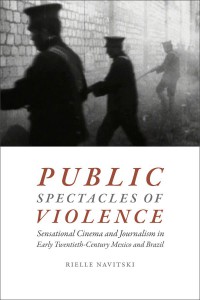
Public Spectacles of Violence
Sensational Cinema and Journalism in Early Twentieth-Century Mexico and Brazil


 (0 vote)
Average rating:
| 0 | rating |  = We can do without = We can do without |
| 0 | rating |  = Good book = Good book |
| 0 | rating |  = Excellent book = Excellent book |
| 0 | rating |  = Unique / a reference = Unique / a reference |
Your rating: -
Book Presentation:
In Public Spectacles of Violence Rielle Navitski examines the proliferation of cinematic and photographic images of criminality, bodily injury, and technological catastrophe in early twentieth-century Mexico and Brazil, which were among Latin America’s most industrialized nations and later developed two of the region’s largest film industries. Navitski analyzes a wide range of sensational cultural forms, from nonfiction films and serial cinema to illustrated police reportage, serial literature, and fan magazines, demonstrating how media spectacles of violence helped audiences make sense of the political instability, high crime rates, and social inequality that came with modernization. In both nations, sensational cinema and journalism—influenced by imported films—forged a common public sphere that reached across the racial, class, and geographic divides accentuated by economic growth and urbanization. Highlighting the human costs of modernization, these media constructed everyday experience as decidedly modern, in that it was marked by the same social ills facing industrialized countries. The legacy of sensational early twentieth-century visual culture remains felt in Mexico and Brazil today, where public displays of violence by the military, police, and organized crime are hypervisible.
About the Author:
Rielle Navitski is Assistant Professor of Theatre and Film Studies at the University of Georgia and coeditor of Cosmopolitan Film Cultures in Latin America, 1896–1960.
Press Reviews:
"Perhaps the most popular—and today the most neglected—genre of silent cinema was the sensational serial film portraying violent and often rebellious action. It was also the most international film form. In this highly original work Rielle Navitski shows how the cinema of early twentieth-century Mexico, with its experience of a recent violent revolution, gave the genre a unique twist, helping to shape a major emerging film industry." - Tom Gunning, coauthor of Fantasia of Color in Early Cinema
"Public Spectacles of Violence is exemplary of the ground-shifting work on silent Latin American cinema of young scholars in English-language film scholarship today. Obsessively delving into archives and producing not only unknown 'data,' but thoroughly well-grounded and original hypotheses about early cinemas in Mexico and Brazil and their intermedial relationships with the popular press and popular sensationalism, Rielle Navitski's book will take its place in the canon as the must-be-referenced book in the field. It is a tour de force of scholarly rigor and ingenuity." - Ana M. Lopez, Professor of Communication, Tulane University
"Public Spectacles is an artful and enthralling reflection on the interaction between urban visual culture forms and the violence of modernization. An excellent text to assign to advanced students." - Jessica Stites Mor, EIAL
"Public Spectacles of Violence is an important contribution to the historiography of Mexican and Brazilian cinematography and of Latin American silent cinema in general. A must for researchers and students interested in the early cinema of Brazil and Mexico." - Pablo Alvira, History
"Public Spectacles of Violence is essential for scholars of Latin American cinema. It offers conceptual and methodological tools that students and scholars of cinema, cultural studies, or history might use to approach the eternally resonant topic of violence and its symbolic representation." - Georgina Torello, Cinema Journal
"[Navitski] has provided new insights into the perception of sensational violence as a mark of modernization, and into the close relationship between journalism and film. This book will be of interest to students and researchers working on early Latin American cinema; the relationship between American and Latin American film; and film and cinema as an expression of Latin American nationalism. For readers outside of film studies who are interested in spectacles of violence, the book presents invaluable research on the roots of the sensational public treatment of violence that we continue to see in Latin American media today." - Corrie Boudreaux, The Latin Americanist
"Public Spectacles of Violence is a compelling, convincing, elegant, and exemplary work of the emerging yet momentous field of Latin American silent cinema studies. It is a great read, a crucial contribution to its sub-specialty and to cinema studies in general, and representative of some of the best new scholarship in the area." - Ernesto R. Acevedo-Muñoz, Studies in 20th & 21st Century Literature
> From the same author:
Transatlantic Cinephilia (2023)
Film Culture between Latin America and France, 1945–1965
Subject: General
Cosmopolitan Film Cultures in Latin America, 1896-1960 (2017)
Dir. Rielle Navitski and Nicolas Poppe
Subject: Countries > Latin America
> On a related topic:

Tastemakers and Tastemaking (2021)
Mexico and Curated Screen Violence
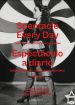
Spectacle Every Day / Espectáculo a diario (2023)
Essays on classical Mexican cinema 1940-1969
Dir. Díaz de la Vega Alonso and Jorge Javier Negrete Camacho
(in English and Spanish)
Woman-Centered Brazilian Cinema (2023)
Filmmakers and Protagonists of the Twenty-First Century
Dir. Jack A. Draper III and Cacilda M. Rêgo
The Lost Cinema of Mexico (2022)
From Lucha Libre to Cine Familiar and Other Churros
Dir. Olivia Cosentino and Brian Price
The White Indians of Mexican Cinema (2022)
Racial Masquerade throughout the Golden Age
 Back
Back

