

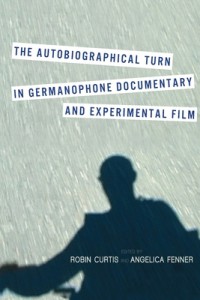
The Autobiographical Turn in Germanophone Documentary and Experimental Film
Edited by Robin Curtis and Angelica Fenner


 (0 vote)
Average rating:
| 0 | rating |  = We can do without = We can do without |
| 0 | rating |  = Good book = Good book |
| 0 | rating |  = Excellent book = Excellent book |
| 0 | rating |  = Unique / a reference = Unique / a reference |
Your rating: -
Book Presentation:
A volume of essays marking out a new, historically and culturally specific model for contemplating autobiographical non-fiction film and video.
There is a widespread notion in the scholarly literature on autobiographical nonfiction film that there are unchanging, universal models for the investigation of the self through audiovisual media. By insisting on the cultural andhistorical specificity of that self, the essays in this volume trace the range of politically and theoretically informed taboos, critiques, and proclivities that shape autobiographical filmmaking in German-speaking countries. Indoing so, they delineate a new model for contemplating autobiographical film and video.
The essays in this volume examine the parameters shaping the audiovisual self in the Germanophone cultural context across a variety of practices and aesthetic modes, from contemporary artists including Hito Steyerl, Ming Wong, and kate hers to Rolf Dieter Brinkmann's multimedia experiments of the 1970s, and from Helke Misselwitz's challenges to the documentary tradition in the GDR to Peter Liechti's investigations of Swiss ambivalence toward the nation's iconic landscape. The volume thus takes up a number of historically and geographically specific iterations of autobiographical discourse that in each case remain contingent on the space and time in which they are uttered.
Contributors: Dagmar Brunow, Steve Choe, Robin Curtis, Tobias Ebbrecht-Hartmann, Angelica Fenner, Marcy Goldberg, Feng-Mei Heberer, Rembert H ser, Waltraud Maierhofer, Christopher Pavsek, Patrik Sj berg, Carrie Smith-Prei, Anna Stainton.
Robin Curtis is Professor of Theory and Practice of Audiovisual Media at the Heinrich-Heine-University in D sseldorf, Germany.
Angelica Fenner is Associate Professor of German and Cinema Studies at the University of Toronto.
See the publisher website: Camden House
> From the same authors:
Women's Film Authorship in Neoliberal Times (2018)
Revisiting Feminism and German Cinema
Dir. Hester Baer and Angelica Fenner

Race Under Reconstruction in German Cinema (2011)
Robert Stemmle's Toxi
> On a related topic:
Jürgen Böttcher and Documentary Film (2024)
Subject: Director > Jürgen Böttcher
After the Avant-Garde (2008)
Contemporary German and Austrian Experimental Film
Dir. Randall Norman Halle and Reinhild Steingröver
Subject: Genre > Experimental
New German Cinema and Its Global Contexts (2025)
A Transnational Art Cinema
Dir. Marco Abel and Jaimey Fisher
Charting Asian German Film History (2025)
Imagination, Collaboration, and Diasporic Representation
Dir. Qinna Qinna Shen, Zach Ramon Fitzpatrick and Qingyang Freya Zhou
Neubau Atmospheres (2025)
East German Cultural Remediations of Modernist Architecture
Transnational German Film at the End of Neoliberalism (2024)
Radical Aesthetics, Radical Politics
Dir. Claudia Breger and Olivia Landry
 Back
Back