


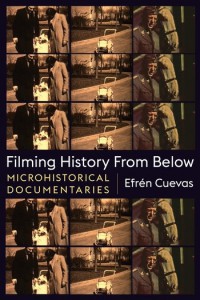
Filming History from Below
Microhistorical Documentaries
by Efrén Cuevas


 (0 vote)
Average rating:
| 0 | rating |  = We can do without = We can do without |
| 0 | rating |  = Good book = Good book |
| 0 | rating |  = Excellent book = Excellent book |
| 0 | rating |  = Unique / a reference = Unique / a reference |
Your rating: -
Book Presentation:
Traditional historical documentaries strive to project a sense of objectivity, producing a top-down view of history that focuses on public events and personalities. In recent decades, in line with historiographical trends advocating “history from below,” a different type of historical documentary has emerged, focusing on tightly circumscribed subjects, personal archives, and first-person perspectives. Efrén Cuevas categorizes these films as “microhistorical documentaries” and examines how they push cinema’s capacity as a producer of historical knowledge in new directions.
Cuevas pinpoints the key features of these documentaries, identifying their parallels with written microhistory: a reduced scale of observation, a central role given to human agency, a conjectural approach to the use of archival sources, and a reliance on narrative structures. Microhistorical documentaries also use tools specific to film to underscore the affective dimension of historical narratives, often incorporating autobiographical and essayistic perspectives, and highlighting the role of the protagonists’ personal memories in the reconstruction of the past. These films generally draw from family archives, with an emphasis on snapshots and home movies.
Filming History from Below examines works including Péter Forgács’s films dealing with the Holocaust such as The Maelstrom and Free Fall; documentaries about the Israeli-Palestinian conflict; Rithy Panh’s work on the Cambodian genocide; films about the internment of Japanese Americans during the Second World War such as A Family Gathering and History and Memory; and Jonas Mekas’s chronicle of migration in his diary film Lost, Lost, Lost.
About the Author:
Efrén Cuevas is a professor in the Department of Culture and Audiovisual Communication at the University of Navarra. He is coeditor of The Man Without the Movie Camera: The Cinema of Alan Berliner (2002) and Landscapes of the Self: The Cinema of Ross McElwee (2008).
Press Reviews:
Cuevas’ monograph achieves its ambitions. It proves that investigative history can be communicated via documentary film; and it demonstrates this potential, in particular, in the case of microhistorical documentaries. Its analysis of home videos as a suitable source is especially strong, revealing how they can be integrated into film and contextualised without drawing upon expository methods. Stuart A. Neave, University of St Andrews, Frames Cinema Journal
Among the many books being published today on film and history, Filming History from Below stands out for the uniqueness of its approach and its excavation of a previously untapped subject. Cuevas shows how microhistorical documentaries significantly broaden our understanding of movements, moments, and people of the past and thus add to the broader discourse of history. Robert Rosenstone, author of History on Film/Film on History
In Filming History From Below, Cuevas coins the term "microhistorical documentary," bringing together two disciplines to examine how documentary film can contribute to a radical, more inclusive understanding of the past. He analyzes films by masters such as Jonas Mekas, Rea Tajiri, Péter Forgács, and Rithy Panh to offer a fresh take on the importance of the perspective ‘from below.’ The films’ subjects relate to burning issues like immigration, statelessness, totalitarianism, and genocide, and Cuevas makes a highly persuasive case for why microhistorical documentary matters. A challenging, original, and important book. Deirdre Boyle, The New School
Cuevas makes a strong and convincing case for the emergence and significance of what he calls the microhistorical documentary. His astute theorization of this category grounds deep, contextualized studies of films by a variety of documentary filmmakers who evince a microhistorical attitude in cinema. This significant, admirably written book will be of interest to anyone concerned with documentary cinema and with representations of history on film. Philip Rosen, author of Change Mummified: Cinema, Historicity, Theory
Efren Cuevas's erudite and insightful study should prove invaluable for present day aficionados of the documentary and remain an influential touchstone well into the future. Cineaste
> On a related topic:
Political Camerawork (2023)
Documentary and the Lasting Impact of Reenacting Historical Trauma
by D. Andy Rice
Subject: Genre > Documentary
Holocaust Representations in Animated Documentaries (2025)
The Contours of Commemoration
Subject: Genre > Historical films

André Bazin on Documentary (2026)
Cinema's Urge to Explore
Dir. André Bazin
Subject: Genre > Documentary

Staging Nuremberg (2026)
How the United States and the Soviet Union Fought Over the Portrayal of Nazi Crimes
Subject: Genre > Documentary

Interactive Documentary and Non-Fiction Media (2026)
Relational Practice and (De)Stabilized Reception
Dir. Tobias Conradi, Florian Krautkrämer and Vanessa Zallot
Subject: Genre > Documentary

The Interactive Documentary Form (2025)
Aesthetics, Practice and Research
Subject: Genre > Documentary
 Back
Back

