

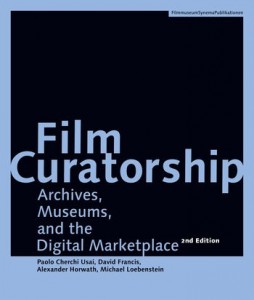
Film Curatorship
Archives, Museums, and the Digital Marketplace
de Paolo Cherchi Usai, David Francis, Alexander Horwath et Michael Loebenstein


 (0 vote)
Moyenne des votes :
| 0 | vote |  = On peut s'en passer = On peut s'en passer |
| 0 | vote |  = Bon livre = Bon livre |
| 0 | vote |  = Excellent livre = Excellent livre |
| 0 | vote |  = Unique / une référence = Unique / une référence |
Votre vote : -
Description de l'ouvrage:
What are the major issues and challenges that film archives, cinémathèques, and film museums are bound to face in the digital age and at a time when there is an expectation of access on demand? What is curatorship, and what does it imply in the context of film preservation and presentation? Is there a concept of “cinema event" that transcends the idea of film as “content” or “art” in the era of information?
Film Curatorship is an experiment: a collective text, a montage of dialogues, conversations, and exchanges among four professionals representing three generations of film archivists and curators. It calls for an open philosophical and ethical debate on fundamental questions the profession must come to terms with in the twenty-first century.
The first edition of this book was jointly published with Le Giornate del Cinema muto, Pordenone, Italy.
The second edition features a new preface by the authors.
À propos des auteurs :
Paolo Cherchi Usai, *1957, is co-founder of the L. Jeffrey Selznick School of Film Preservation at the George Eastman Museum and of the Pordenone Silent Film Festival, and former Director of the National Film and Sound Archive of Australia (2004–2008). He directed Passio (2007), a film adaptation of The Death of Cinema (BFI Publishing, 2001). His latest book is Silent Cinema. A Guide to Study, Research and Curatorship (Bloomsbury, 2019). He is currently Director of the School of Film Preservation at the Centro Sperimentale di Cinematografia in Italy. David Francis OBE, *1935, was for 16 years Curator of the British National Film Archive, where he established the J. Paul Getty Jnr. Conservation Centre (Berkhamsted), and from 1991 until 2001 was Chief of the Motion Picture, Broadcasting, and Recorded Sound Division of the Library of Congress, where he was responsible for the planning and design of the Library of Congress National Audio-Visual Conservation Center’s state-of-the-art Packard Campus in Culpeper, Virginia. His many publications include the groundbreaking study Chaplin: Genesis of a Clown (Quartet, 1977), written with Raoul Sobel. He is the founder (with Prof. Joss Marsh) of the Kent Museum of the Moving Image in Deal (United Kingdom), a not-for-profit museum that explores the deep history of the moving image. Alexander Horwath, *1964 in Vienna, is an internationally acclaimed film curator and critic, former Director of the Viennale – Vienna International Film Festival (1992–1997), and former Director of the Austrian Film Museum (2002–2017). He is the author and (co-)editor of publications on American cinema of the 1960s and 70s, Austrian avant-garde film, and film-makers such as Josef von Sternberg, Michael Haneke, and Ruth Beckermann. Michael Loebenstein, *1974 in Vienna, has worked as a freelance writer and critic, film programmer, and DVD author, and in 2004 joined the Austrian Film Museum as a curator and researcher. From 2011 to 2017 he was Director of the National Film and Sound Archive of Australia. Since fall 2017 he is Director of the Austrian Film Museum. He currently serves as Secretary-General of FIAF – the International Federation of Film Archives.
Revue de Presse:
A fascinating examination of the nature of cinema itself. Sight & Sound
The volume on hand is actually about curatorship in the original sense: how people build up a collection of (art) objects and related materials, take care of the corpus created, and show parts of it in a way that makes sense of the objects and thus helps create further levels of enlightenment and meaning. CinemaScope
> Des mêmes auteurs :
Provenance and Early Cinema (2021)
de Joanne Bernardi, Paolo Cherchi Usai, Tami Williams et Joshua Yumibe
Sujet : Silent Cinema

Josef von Sternberg (2008)
The Case of Lena Smith
Dir. Alexander Horwath et Michael Omasta
Sujet : One Film > The Case of Lena Smith
The Last Great American Picture Show (2004)
New Hollywood Cinema in the 1970s
Dir. Thomas Elsaesser, Noel King et Alexander Horwath
Sujet : Countries > United States
> Sur un thème proche :
Scratches and Glitches (2021)
Observations on Preserving and Exhibiting Cinema in the Early 21st Century
de Jurij Meden
Sujet : Economics
The Film Museum Practice and Film Historiography (2017)
The Case of the Nederlands Filmmuseum
Sujet : Economics
The Past Is a Moving Picture (2014)
Preserving the Twentieth Century on Film
de Janna Jones
Sujet : Economics
Cinephemera (2014)
Archives, Ephemeral Cinema, and New Screen Histories in Canada
de Zoe Druick et Gerda Cammaer
Sujet : Economics
Counter-Archive (2010)
Film, the Everyday, and Albert Kahn's Archives de la Planète
de Paula Amad
Sujet : Genre > Documentary
A Thousand Cuts (2016)
The Bizarre Underground World of Collectors and Dealers Who Saved the Movies
de Dennis Bartok et Jeff Joseph
Sujet : Economics
 Retour

