


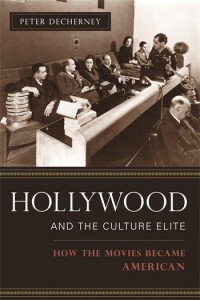
Hollywood and the Culture Elite
How the Movies Became American


 (0 vote)
Average rating:
| 0 | rating |  = We can do without = We can do without |
| 0 | rating |  = Good book = Good book |
| 0 | rating |  = Excellent book = Excellent book |
| 0 | rating |  = Unique / a reference = Unique / a reference |
Your rating: -
Book Presentation:
As Americans flocked to the movies during the first part of the twentieth century, the guardians of culture grew worried about their diminishing influence on American art, education, and American identity itself. Meanwhile, Hollywood studio heads were eager to stabilize their industry, solidify their place in mainstream society, and expand their new but tenuous hold on American popular culture.
Peter Decherney explores how these needs coalesced and led to the development of a symbiotic relationship between the film industry and America's stewards of high culture. Formed during Hollywood's Golden Age (1915-1960), this unlikely partnership ultimately insured prominent places in American culture for both the movie industry and elite cultural institutions. It redefined Hollywood as an ideal American industry; it made movies an art form instead of simply entertainment for the masses; and it made moviegoing a vital civic institution. For their part, museums and universities used films to maintain their position as quintessential American institutions.
As the book delves into the ties between Hollywood bigwigs and various cultural leaders, an intriguing cast of characters emerges, including the poet Vachel Lindsay, film producers Adolph Zukor and Joseph Kennedy, Hollywood flak and censor extraordinaire Will Hays, and philanthropist turned politician Nelson Rockefeller. Decherney considers how Columbia University's film studies program helped integrate Jewish students into American culture while also professionalizing screenwriting. He examines MoMA's career-savvy film curator Iris Barry, a British feminist once dedicated to stemming the tide of U.S. cultural imperialism, who ultimately worked with Hollywood and the U.S. government to fight fascism and communism and promote American values abroad. Other chapters explore Vachel Lindsay's progressive vision of movies as reinvigorating the public sphere through film libraries and museums; the promotion of movie connoisseurship at Harvard and other universities; and how the heir of a railroad magnate bankrolled the American avant-garde film movement.
Amid ethnic diversity, the rise of mass entertainment, world war, and the global spread of American culture, Hollywood and cultural institutions worked together to insure their own survival and profitability and to provide a coherent, though shifting, American identity.
About the Author:
Peter Decherney is assistant professor of cinema studies and English at the University of Pennsylvania.
Press Reviews:
It is in the author's discussion of these Cold War happenings that the narrative becomes almost cloak-and-dagger. Publishers Weekly
A clearly written and well-researched historical work that makes a strong contribution to film scholarship. Heidi Kenaga, The Moving Image
A frequently profound ethical query into the costs of patronage. Kevin Hagopian, Film Quarterly
Thought-provoking. The American Historical Review
Decherney does an excellent job exploring the individual players
and exposing how our current cinematic institutions and assumptions regarding film were founded. Erin Hills-Parks, Film & History
A very significant work that demands attentive and critical engagement. Tom Crosbie, Screening the Past
> From the same author:
Iranian Cinema in a Global Context (2018)
Policy, Politics, and Form
Dir. Peter Decherney and Blake Atwood

> On a related topic:
The United States Constitution in Film (2020)
Part of Our National Culture
by Eric T. Kasper and Quentin D. Vieregge
Subject: Sociology

Imperial Affects (2017)
Sensational Melodrama and the Attractions of American Cinema
by Jonna Eagle
Subject: Countries > United States
Un-American Psycho (2012)
Brian De Palma and the Political Invisible
by Chris Dumas
Subject: Director > Brian de Palma

Movie-Made America (1994)
A Cultural History of American Movies
by Robert Sklar
Subject: Countries > United States

 Back
Back

