


Hollywood and the Great Depression
American Film, Politics and Society in the 1930s
Sous la direction de Iwan Morgan et Philip John Davies

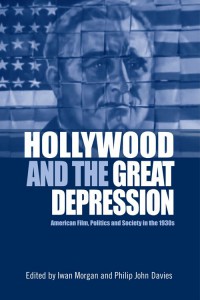

 (0 vote)
Moyenne des votes :
| 0 | vote |  = On peut s'en passer = On peut s'en passer |
| 0 | vote |  = Bon livre = Bon livre |
| 0 | vote |  = Excellent livre = Excellent livre |
| 0 | vote |  = Unique / une référence = Unique / une référence |
Votre vote : -
Description de l'ouvrage:
Examines how Hollywood responded to and reflected the political and social changes that America experienced during the 1930s
In the popular imagination, 1930s Hollywood was a dream factory producing escapist movies to distract the American people from the greatest economic crisis in their nation’s history. But while many films of the period conform to this stereotype, there were a significant number that promoted a message, either explicitly or implicitly, in support of the political, social and economic change broadly associated with President Franklin D. Roosevelt’s New Deal programme. At the same time, Hollywood was in the forefront of challenging traditional gender roles, both in terms of movie representations of women and the role of women within the studio system. With case studies of actors like Shirley Temple, Cary Grant and Fred Astaire, as well as a selection of films that reflect politics and society in the Depression decade, this fascinating book examines how the challenges of the Great Depression impacted on Hollywood and how it responded to them.
Topics covered include:
• How Hollywood offered positive representations of working women
• Congressional investigations of big-studio monopolization over movie distribution
• How three different types of musical genres related in different ways to the Great Depression – the Warner Bros Great Depression Musicals of 1933, the Astaire/Rogers movies, and the MGM ‘kids’ musicals of the late 1930s
• The problems of independent production exemplified in King Vidor’s Our Daily Bread
• Cary Grant’s success in developing a debonair screen persona amid Depression conditionsContributors
• Harvey G. Cohen, King’s College London
• Philip John Davies, British Library
• David Eldridge, University of Hull
• Peter William Evans, Queen Mary, University of London
• Mark Glancy, Queen Mary University of London
• Ina Rae Hark, University of South Carolina
• Iwan Morgan, University College London
• Brian Neve, University of Bath
• Ian Scott, University of Manchester
• Anna Siomopoulos, Bentley University
• J. E. Smyth, University of Warwick
• Melvyn Stokes, University College London
• Mark Wheeler, London Metropolitan University
À propos des auteurs :
Professor Iwan Morgan is Professor of US Studies and Commonwealth Fund Professor of American History, University College London.
Philip John Davies is Professor in American Studies at De Montfort University.
Revue de Presse:
The articles in this collection serve to bring new information to light, challenge some ideas about Depression-era film and deepen readers’ understanding of other aspects of the film industry in the 1930s.'– Richard Bodek, College of Charleston, Historical Journal of Film, Radio and Television
The articles in this collection serve to bring new information to light, challenge some ideas about Depression-era film and deepen readers’ understanding of other aspects of the film industry in the 1930s.– Richard Bodek, College of Charleston, Historical Journal of Film, Radio and Television
This stimulating collection energetically revisits and frequently revises the history of Hollywood’s political engagements during the height of its cultural influence in the 1930s, offering new insights into the responses of writers, stars, moguls and distributors to the Depression and New Deal, and their expression in some of the decade’s most memorable movies.'– Professor Richard Maltby, Flinders University
Voir le site internet de l'éditeur Edinburgh University Press
> Des mêmes auteurs :

> Sur un thème proche :
The Hollywood Social Problem Film (1981)
Madness, despair, and politics from the Depression to the fifties
de Peter Roffman et Jim Purdy
Sujet : Countries > United States



Cinema and the Wealth of Nations (2017)
Media, Capital, and the Liberal World System
Sujet : Sociology

Images of Unrest (2026)
Documentary Film and Political Violence
de Nikolaj Lübecker et Daniele Rugo
Sujet : Sociology

Kinotopias (2026)
Film, Place and Belonging in a Bordered World
de Kevin Smets, Lennart Soberon, Irene Gutiérrez-Torres et Silvia Almenara-Niebla
Sujet : Sociology
 Retour