


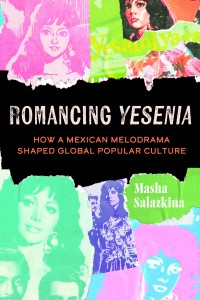
Romancing Yesenia
How a Mexican Melodrama Shaped Global Popular Culture


 (0 vote)
Average rating:
| 0 | rating |  = We can do without = We can do without |
| 0 | rating |  = Good book = Good book |
| 0 | rating |  = Excellent book = Excellent book |
| 0 | rating |  = Unique / a reference = Unique / a reference |
Your rating: -
Book Presentation:
This book follows the production, transnational circulation, and reception of the highest grossing film in the history of Soviet exhibition, the 1971 Mexican romance Yesenia. The film adaptation of a telenovela based on a wildly popular graphic novel set during the Second Franco-Mexican War became a surprise hit in the USSR, selling more than ninety million tickets in the first year of its Soviet release alone. Drawing on years of archival research, renowned film scholar Masha Salazkina takes Yesenia’s unprecedented popularity as an entry point into a wide-ranging exploration of the cultures of Mexico and the Soviet Union in the 1970s and of the ways in which popular culture circulated globally. Paying particular attention to the shifting landscape of sexual politics, Romancing "Yesenia" argues for the enduring importance and ideological ambiguities of melodramatic forms in global popular media.
About the Author:
Masha Salazkina is Professor of Film Studies at Concordia University, Montreal. She is author of World Socialist Cinema: Alliances, Affinities, and Solidarities in the Global Cold War and In Excess: Sergei Eisenstein's Mexico. She is also coeditor of Global Perspectives on Amateur Film Histories and Cultures and Sound, Speech, Music in Soviet and Post-Soviet Cinema.
Press Reviews:
"In 1975 the Mexican melodrama Yesenia took the Soviet Union by storm to become the highest grossing film in the history of film exhibition there—to the anger of Russian elites. We rush to read Masha Salazkina’s account to find out how we missed this important chapter in world film distribution history. The answer is that there is no such chapter because no other scholar in the field could pull off this international tour de force—an exhaustive cross-cultural analysis of a single melodrama, a continent-crossing that connects the telenovela tradition with Mexican Golden Age cinema as well as Soviet era melodrama. Salazkina tells us that we should have known that the contemporary 'global-popular' is not new, setting the bar high for another generation of multilingual world culture critics."—Jane M. Gaines, author of Pink-Slipped: What Happened to Women in the Silent Film Industry?
"What does film history look like when we bypass the Global North? This is the historiographic provocation at the heart of Romancing 'Yesenia,' a book that will serve as a model for transnational film histories to come. Salazkina moves with ease between Latin American studies and Russian and post-Soviet studies to reconstruct the unlikely global media circuit between Latin America and the Soviet Union. Offering an account of how the transculturation of the Latin American melodrama through the lens of Soviet vernacular culture produced a transnational affective space, Salazkina also challenges both the national allegorical readings of non-Western texts as well as the European literary and Hollywood film canon of melodrama studies."—Nilo Couret, author of Mock Classicism: Latin American Film Comedy, 1930–1960
See the publisher website: University of California Press
See Yesenia (1971) on IMDB ...
> From the same author:


World Socialist Cinema (2023)
Alliances, Affinities, and Solidarities in the Global Cold War
Subject: Sociology
Global Perspectives on Amateur Film Histories and Cultures (2021)
Dir. Masha Salazkina and Enrique Fibla
Subject: Sociology
> On a related topic:

Mexican Melodrama (2016)
Film and Nation from the Golden Age to the New Wave

Alambrista and the U.S.-Mexico Border (2004)
Film, Music, and Stories of Undocumented Immigrants
Dir. Nicholas J. Cull and Davíd Carrasco
Subject: One Film > Alambrista!


Spectacle Every Day / Espectáculo a diario (2023)
Essays on classical Mexican cinema 1940-1969
Dir. Díaz de la Vega Alonso and Jorge Javier Negrete Camacho
(in English and Spanish)

Border Witness (2023)
Reimagining the US-Mexico Borderlands through Film
by Michael Dear
Subject: Sociology


Woman-Centered Brazilian Cinema (2023)
Filmmakers and Protagonists of the Twenty-First Century
Dir. Jack A. Draper III and Cacilda M. Rêgo

The Lost Cinema of Mexico (2022)
From Lucha Libre to Cine Familiar and Other Churros
Dir. Olivia Cosentino and Brian Price

The White Indians of Mexican Cinema (2022)
Racial Masquerade throughout the Golden Age

 Back
Back

