

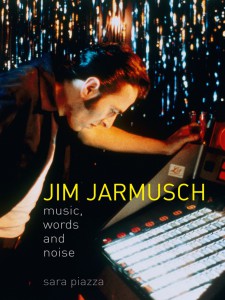
Jim Jarmusch
Music, Words and Noise
by Sara Piazza


 (0 vote)
Average rating:
| 0 | rating |  = We can do without = We can do without |
| 0 | rating |  = Good book = Good book |
| 0 | rating |  = Excellent book = Excellent book |
| 0 | rating |  = Unique / a reference = Unique / a reference |
Your rating: -
Book Presentation:
Jim Jarmusch: Music, Words and Noise is the first book to examine the films of Jim Jarmusch from a sound-oriented perspective. The three essential acoustic elements that structure a film— music, words and noise—propel this book’s fascinating journey through his work. Exploring the director’s extensive back catalogue, including Stranger Than Paradise, Down By Law, Dead Man, and Only Lovers Left Alive, Sara Piazza’s unique reading reveals how Jarmusch created a form of “sound democracy” in film, in which all acoustic layers are capable of infiltrating each other and in which sound is not subordinate to the visual. In his cultural melting pot, hierarchies are irrelevant: Schubert and Japanese noise-bands, Marlowe and Betty Boop, can coexist easily side-by-side. Developing the innovative idea of a “silent-sound film,” Piazza identifies prefiguring elements from pre-sound-era film in Jarmusch’s work.
Highlighting the importance of Jarmusch’s treatment of sound, Piazza investigates how the director’s distinctive reputation consolidated itself over the course of a thirty-year career. Based in New York, Jarmusch was able to develop a fiercely personal vision far from the commercial pressures of Hollywood. The book uses wide-ranging examples from music, film, literature, and visual art, and features interviews with many prominent figures, including Ennio Morricone, Luc Sante, Roberto Benigni, John Lurie, and Jarmusch himself.
An innovative account of a much-admired body of work, Jim Jarmusch will appeal not only to the many fans of the director but all those interested in the connections between sound and film.
Visit the author's page for this book: http://jimjarmusch-musicwordsandnoise.com
Press Reviews:
“Piazza’s book is a lengthy and detailed study of Jarmusch that intelligently explores his work in terms of sound and which does draw on a few academic sources. . . . Piazza doesn’t merely analyze how sound functions within his films but argues for the importance of sound in terms of how it structures and permeates them. In focusing on how three sonic aspects work in his films—music, words and noise . . . her analyses on the whole are sophisticated and rich . . . an excellent and highly recommended book, which contains some extremely insightful reflections on Jarmusch’s art.”
Viewfinder
“The work is a much-needed—and excellent—addition to the limited number of publications dedicated to a very influential and well respected filmmaker. . . . This book is an essential companion to the cinema, music, and poetry of Jarmusch and is accessible to both devotees of the filmmaker and newcomers to his work. It will be of interest for film scholars and students, cinema and music lovers alike.”
Senses of Cinema
“Sara Piazza has sought to peel away some of the dense layers of Jarmusch’s identity in this intelligently written book that suggests that sound without vision is only half of the big picture.”
Monacle Magazine
“The book serves as an important and compelling model for film criticism/film scholarship that engages with and makes itself legible to non-academic cinephiles. The book balances close readings of Jarmusch’s filmography with historical background and personal interviews. Unlike many single-subject volumes aimed at the general public, Piazza never allows her book to devolve into a simple hagiography (despite her clear affinity for Jarmusch’s work). What she has produced, instead, is a genuine critical history of an important filmmaker, and the shifting, complicated, and rich historical and cultural contexts in which he lived and worked.”
Historical Journal of Film, Radio and Television
“You’ll come away wanting to see a Jim Jarmusch film if you haven’t seen one, and to put this stuff to the test.”
The Quietus
See the publisher website: Reaktion Books
See the complete filmography of Jim Jarmusch on the website: IMDB ...
> Books with the same or similar title:
> On a related topic:
Music and Sound in the Worlds of Michel Gondry (2022)
Subject: Director > Michel Gondry
Andrei Tarkovsky's Sounding Cinema (2019)
Music and Meaning from Solaris to The Sacrifice
Subject: Director > Andrei Tarkovsky
Sonatas, Screams, and Silence (2015)
Music and Sound in the Films of Ingmar Bergman
by Alexis Luko
Subject: Director > Ingmar Bergman
Robert Altman's Soundtracks (2014)
Film, Music, and Sound from M*A*S*H to A Prairie Home Companion
Subject: Director > Robert Altman
Working Musicians (2023)
Labor and Creativity in Film and Television Production
Subject: Jobs and Trainings
 Back
Back