

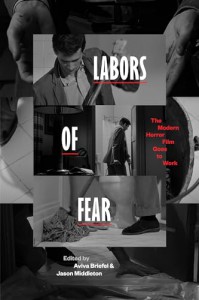
Labors of Fear
The Modern Horror Film Goes to Work
Sous la direction de Aviva Briefel et Jason Middleton


 (0 vote)
Moyenne des votes :
| 0 | vote |  = On peut s'en passer = On peut s'en passer |
| 0 | vote |  = Bon livre = Bon livre |
| 0 | vote |  = Excellent livre = Excellent livre |
| 0 | vote |  = Unique / une référence = Unique / une référence |
Votre vote : -
Description de l'ouvrage:
How work and capitalism inspire horror in modern film.
American ideals position work as a source of pride, opportunity, and meaning. Yet the ravages of labor are constant grist for horror films. Going back decades to the mad scientists of classic cinema, the menial motel job that prepares Norman Bates for his crimes in Psycho, and the unemployed slaughterhouse workers of The Texas Chain Saw Massacre, horror movies have made the case that work is not so much a point of pride as a source of monstrosity.
Editors Aviva Briefel and Jason Middleton assemble the first study of horror’s critique of labor. In the 1970s and 1980s, films such as The Shining and Dawn of the Dead responded to deindustrialization, automation, globalization, and rising numbers of women in the workforce. Labors of Fear explores these critical issues and extends them in discussions of recent works such as The Autopsy of Jane Doe, Midsommar, Survival of the Dead, It Follows, Get Out, and Us. Covering films ranging from the 1970s onward, these essays address novel and newly recognized modes and conditions of labor: reproductive labor, emotion work and emotional labor, social media and self-branding, intellectual labor, service work, precarity, and underemployment. In its singular way, horror continues to make spine-tingling sense of what is most destructive in the wider sociopolitical context of US capitalism.
À propos des auteurs :
Aviva Briefel is the Edward Little Professor of the English Language and Literature and Cinema Studies at Bowdoin College and the coeditor of Horror after 9/11: World of Fear, Cinema of Terror.
Jason Middleton is an associate professor of English and film and media studies at the University of Rochester and the author of Documentary’s Awkward Turn: Cringe Comedy and Media Spectatorship.
Revue de Presse:
An intriguing array of essays that consider horror and various forms of labor and work. . . By analyzing and reflecting on these films—and how labor and work in all their forms relate to the terror of the contemporary—this collection illuminates the fears and frights to be found not only in the cinema but also in one's own occupations.
— CHOICE
Labors of Fear makes a strong case that the horror genre has, in fact, understood that work is a monstrous presence in most of our lives all along, and the genre has been offering the resources to help us rethink what work can and should be . . . Thus, one of the main accomplishments of Labors of Fear is the simple act of lingering on aspects of work . . . It’s all presented in clear, readable prose, with a minimum of footnotes—well suited for both academics looking to use these essays as jumping-off points for their own work and for horror viewers wanting to find new ways to pay attention to their favorite films.
— Los Angeles Review of Books
From the very introduction of Labors of Fear: The Modern Horror Film Goes to Work, editors Aviva Briefel and Jason Middleton posit that modern horror films challenge the concept of the so-called American dream in unique and complex ways . . . The beauty of such a conception is that is allows for a plethora of approaches and associated themes, as evidenced by the chapters that follow . . . Labors of Fear presents ground-breaking additions to the field. Altogether, the innovative nature and plasticity of this text makes it an invaluable addition to the library of many scholars interested in horror studies, film, and associated topics.
— The Journal of Popular Culture
Not only a groundbreaking study of its own accord, but also stands as an inspiring call for further work on horror and/of labour. It is both a fascinating critical accompaniment to the films it covers, and an important standalone scholarly intervention.
— Monstrum
Voir le site internet de l'éditeur University of Texas Press
> Des mêmes auteurs :
> Sur un thème proche :
Believable Impossibilities (2026)
Race, Testimony, and the Horror Film
Queer for Fear (2024)
Horror Film and the Queer Spectator
Horror and Science Fiction Cinema and Society (2024)
American Culture and Politics in the Cold War and After Through the Projector Lens
The Exorcist Effect (2023)
Horror, Religion, and Demonic Belief
Japanese Horror Culture (2023)
Critical Essays on Film, Literature, Anime, Video Games
Dir. Fernando Gabriel Pagnoni Berns, Subashish Bhattacharjee et Ananya Saha
 Retour