


Cinema + Revolution
The Life and Work of Masao Adachi
Edited by Go Hirasawa and Ethan Spigland

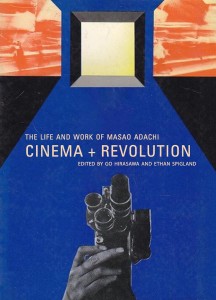

 (0 vote)
Average rating:
| 0 | rating |  = We can do without |
| 0 | rating |  = Good book |
| 0 | rating |  = Excellent book |
| 0 | rating |  = Unique / a reference |
Your rating: -
Book Presentation:
A book-length interview and career retrospective of seminal Japanese filmmaker and political militant Masao Adachi.
Cinema + Revolution: The Life and Work of Masao Adachi is the first-ever full-length interview and career retrospective of legendary filmmaker and militant Masao Adachi. These interviews, conducted and edited by Go Hirasawa and Ethan Spigland, offer readers unprecedented access to Adachi's reflections on a life lived at the intersection of cinema and radical politics. Rising to prominence in 1960s Japan as an experimental filmmaker and theorist, Adachi helped define the avant-garde cinema of the era with formally daring works like A.K.A. Serial Killer (1969) and Gushing Prayer (1970). In the early 1970s, he left Japan to join the armed struggle in the Middle East, spending nearly three decades in Lebanon with the Japanese Red Army and the Popular Front for the Liberation of Palestine before his arrest, extradition, and imprisonment in 2000
Cinema + Revolution is a documentary experiment in dialogue form, weaving Adachi's own voice together with critical analysis, archival materials, and newly translated texts from his theoretical writings. From his formative years in the Japanese New Wave to his collaborations with Koji Wakamatsu and Nagisa Oshima, from exile and incarceration to his recent films on contemporary political violence, Adachi recounts a trajectory that illuminates the possibilities and costs of revolutionary commitment. Essential reading for anyone interested in radical history, film studies, or the enduring question of what it means to align one's art with one's politics.
About the authors:
Go Hirasawa is a film programmer and curator. He has organized special screenings and exhibitions focusing on Japanese cinema and art of the 1960s and 1970s at various art theaters, cinematheques, and film festivals, as well as art museums in Japan and abroad. In 2021, he received a PhD from the Graduate School of Humanities at Leiden University and the Université Sorbonne Nouvelle. His most recent publication, Expanded Cinema and Intermedia: Critical Texts of the 1960s (coedited by Ann Adachi-Tasch and Julian Ross), came out in 2020. He also organized the film screening event Japanese Cinema Expanded at the Museum of Modern Art in New York in 2021.Ethan Spigland is a professor in the Humanities and Media Studies Department at Pratt Institute. He received an MFA from the Graduate Film Program at Tisch School of the Arts, New York University, and a maitrîse in Philosophy from the University of Paris VIII under the supervision of Gilles Deleuze and Jean-François Lyotard. Ethan is also an award-winning screenwriter, filmmaker, visual artist, critic, and curator. His project, Elevator Moods, was featured in the Sundance Film Festival and South By Southwest, and won a Webby Award in the Broadband Category. His short film, The Strange Case of Balthazar Hyppolite, won the Gold Medal in the Student Academy Awards, and was shortlisted for an Oscar.
See the publisher website: Inpatient Press
See the complete filmography of Masao Adachi on the website: IMDB ...
> On a related topic:

Re-Viewing the Past (2020)
The Uses of History in the Cinema of Imperial Japan
Persistently Postwar (2019)
Media and the Politics of Memory in Japan
Dir. Blai Guarné, Artur Lozano-Méndez and Dolores P. Martinez

Ninagawa Mika, Miyake Kyoko and Ando Momoko (2026)
Shōjo Dreams and Unruly Idols
Subject: Director > Ninagawa Mika, Miyake Kyoko, Ando Momoko
Kurosawa, Shakespeare and Others (2023)
Art and the Human Experience
by Anne-Marie Costantini-Cornède
Subject: Director > Akira Kurosawa

Negative, Nonsensical, and Non-conformist (2023)
The Films of Suzuki Seijun
Subject: Director > Suzuki Seijun
 Back


