


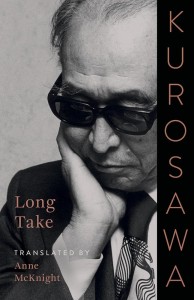
Long Take


 (0 vote)
Average rating:
| 0 | rating |  = We can do without = We can do without |
| 0 | rating |  = Good book = Good book |
| 0 | rating |  = Excellent book = Excellent book |
| 0 | rating |  = Unique / a reference = Unique / a reference |
Your rating: -
Book Presentation:
A multifaceted portrait of the great Japanese director.
For years, Akira Kurosawa resisted writing about himself. “It would turn out to be nothing but talk about movies,” he said. “In other words, take myself, subtract movies, and the result is zero.” The memoir he finally started serializing in 1978, Something like an Autobiography, ended with Rashomon, the film that launched him on the world’s stage in 1950. Long Take, first published in Japan shortly after Kurosawa’s death in 1998, at last tells the story of the rest of his life.
By turns intimate, provocative, and revealing, Long Take creates a dynamic portrait of Kurosawa from his own writings; his conversations with writer Inoue Hisashi and director Yamada Yōji; and essays by his daughter and colleague Kurosawa Kazuko, who details the collaborative history of the “Kurosawa crew.” It features a wealth of industry lore, cultural reference points, inside jokes with other filmmakers and writers, and backstories for his own productions, from the earliest to the last. Of particular interest to all cinephiles is an annotated list of Kurosawa’s 100 favorite films.
A survey of Kurosawa’s prodigious career, this book situates the visionary in the media milieu of his youth, in the literature and performing arts of twentieth-century Japan and Hollywood, and among the myriad films he loved, admired, and referenced, including Japanese silent film and comedy as well as productions from India, Iran, and Soviet-era Russia. Now available to English readers for the first time, Long Take offers a lasting picture of the peerless filmmaker in his element.
About the Author:
Akira Kurosawa (1910–1998) was a Japanese filmmaker, widely considered one of the most important and influential in the history of cinema. He directed thirty films, including Drunken Angel (1948), Rashomon (1950), Seven Samurai (1954), The Hidden Fortress (1958), and Kagemusha (1980). Anne McKnight is associate professor of Japanese and comparative literature at the University of California, Riverside. She is author of Nakagami, Japan: Buraku and the Writing of Ethnicity, also published by the University of Minnesota Press.
Press Reviews:
"Unobtrusively creative, Long Take is a tour de force synthesizing much of the best scholarship on Akira Kurosawa into an illuminating reconsideration of the director as both artist and critic. This is a must-read for anyone interested in Kurosawa, cinema, or Japanese cultural production of the twentieth century."―Kerim Yasar, author of Electrified Voices: How the Telephone, Phonograph, and Radio Shaped Modern Japan, 1868–1945
"In today’s world, the films of Akira Kurosawa are more relevant and significant than ever. Long Take, accompanied by Anne McKnight’s insightful essay, serves as an excellent introduction to the filmmaker, and for those already familiar with his work, the book offers fresh perspectives and valuable insights that deepen appreciation for Kurosawa’s films."―Mitsuhiro Yoshimoto, author of Kurosawa: Film Studies and Japanese Cinema
"Translator McKnight does an excellent job clarifying the particulars of the Japanese film industry and cultural norms."―Kirkus Reviews
See the publisher website: University of Minnesota Press
See the complete filmography of Akira Kurosawa on the website: IMDB ...
> Books with the same or similar title:
> From the same author:

> On a related topic:
The Russian Kurosawa (2023)
Transnational Cinema, or the Art of Speaking Differently
Subject: Director > Akira Kurosawa
Kurosawa, Shakespeare and Others (2023)
Art and the Human Experience
by Anne-Marie Costantini-Cornède
Subject: Director > Akira Kurosawa
Rashomon Effects (2018)
Kurosawa, Rashomon and their legacies
Dir. Blair Davis, Robert Anderson and Jan Walls
Ninagawa Mika, Miyake Kyoko and Ando Momoko (2026)
Shōjo Dreams and Unruly Idols
Subject: Director > Ninagawa Mika, Miyake Kyoko, Ando Momoko
 Back
Back

