

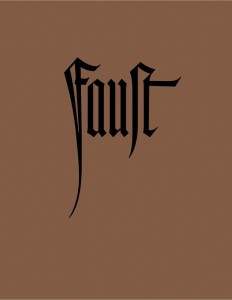
The Faust Bible
The Making of F.W. Murnau's Masterpiece
Edited by Laurent Mannoni


 (0 vote)
Average rating:
| 0 | rating |  = We can do without = We can do without |
| 0 | rating |  = Good book = Good book |
| 0 | rating |  = Excellent book = Excellent book |
| 0 | rating |  = Unique / a reference = Unique / a reference |
Your rating: -
Book Presentation:
Presenting a never-before-published treasure of film history: a visual diary made by the set designers of F.W. Murnau's seminal classic of silent cinema Faust.
The Faust Bible: The Making of F.W. Murnau’s Masterpiece brings to light an astounding, recently-unearthed artefact of film history: a visual diary dedicated to the making of a towering classic of silent cinema. This new book stunningly recreates, in full, a collection of set photography, original illustrations, and behind the scenes images carefully compiled by the film’s set designer inside a prop Bible on the set of Faust (1926). Published in association with the Cinémathèque Française, The Faust Bible offers an unparalleled window into the making of F.W. Murnau’s marvel of German Expressionist cinema. One of the most influential and pioneering silent-era filmmakers, F.W. Murnau was known for his private film sets, reluctant to share the secrets of his mastery of light and shadow. But for this final film shot in Germany before his relocation to Hollywood, he was gifted a remarkable memento from the production―a collection of photographs and illustrations documenting the making of the film almost step by step, inside a prop Bible. Compiled by the film’s set designer Robert Herlth, the astounding visual diary housed approximately 400 original images. The Faust Bible recreates, in full, this stunning artefact of film history. Through a vast array of stills and sketches, the audacious skill at the heart of Murnau’s production―innovative practical effects, lavish costuming and set design, detailed storyboarding― is showcased, bringing the film to life on the printed page.
About the Author:
Laurent Mannoni is Director of Heritage at the Cinémathèque Française, Paris. Stefan Drössler is Director of the Filmmuseum München, Munich. K.J. Relth-Miller is Director of Film Programs at the Academy Museum, California.
See the publisher website: MUBI
See Fausto (1926) on IMDB ...
> From the same author:
The Great Art Of Light And Shadow (2000)
Archaeology of the Cinema
by Laurent Mannoni and Richard Crangle
Subject: History of Cinema
> On a related topic:
Expressionism and Film (2016)
by Rudolf Kurtz, Christian Kiening and Ulrich Johannes Beil
Subject: Technique > Aesthetics
The Haunted Screen (2008)
Expressionism in the German Cinema and the Influence of Max Reinhardt
Weimar Cinema and After (2000)
Germany's Historical Imaginary

Danish and German Silent Cinema (2025)
Towards a Common Film Culture
Dir. Lars-Martin Sørensen and Casper Tybjerg
Subject: Silent Cinema
 Back
Back

