

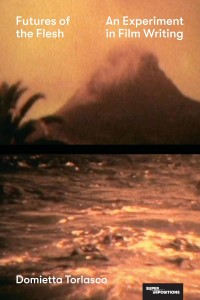
Futures of the Flesh
An Experiment in Film Writing


 (0 vote)
Average rating:
| 0 | rating |  = We can do without = We can do without |
| 0 | rating |  = Good book = Good book |
| 0 | rating |  = Excellent book = Excellent book |
| 0 | rating |  = Unique / a reference = Unique / a reference |
Your rating: -
Book Presentation:
Exploring alternative possibilities of viewpoint through cinematic experimentation
In this boldly multidimensional work, Domietta Torlasco alternates between theoretical writings, film essays, and fragmented excerpts from an original screenplay to construct a temporal as well as spatial architecture for her critical intervention. Futures of the Flesh posits that cinematic experimentation holds the strongest potential to reimagine life―its forms, rhythms, and affects―beyond the division between subject and object, human and animal, animate and inanimate. Such potential cannot be clearly located in either space or time but, on the contrary, requires that we think according to momentum, diffraction, and difference.
As a novel notion and the formative medium of both subject and object, the flesh affirms the openness and indefinite generativity of being, allowing for the appearance of new perceptual relations and forms of kinship. Torlasco stages a dialogue between thinkers including Hortense Spillers and Maurice Merleau-Ponty and turns to canonical films, including Blade Runner and Solaris, classic sci-fi literature, such as Octavia Butler’s Kindred, and contemporary video art to elucidate how these media imaginatively rework the distinction between categories of being. This book endeavors to redefine the relation between theory and practice, analysis and creation, to name the primary relations that, under specific techno-aesthetic conditions, enable the emergence of porous, un-bordered forms of life.
About the Author:
DOMIETTA TORLASCO is a critical theorist, filmmaker, and professor of comparative literature at Northwestern University. She is the author of four books, including The Rhythm of Images: Cinema Beyond Measure. Her video essays have screened at the Los Angeles Museum of Contemporary Art in Los Angeles, the Walker Art Center in Minneapolis, and Kino Arsenal in Berlin, among others.
Press Reviews:
"Drawing on the most radical insights from Black feminist scholarship, Torlasco's audacious braiding of creative and scholarly genres of film writing takes to task some of the most threaded modes of film theory. Futures of the Flesh is difficult work of extraordinary beauty and accomplishment." ―Alessandra Raengo, Georgia State University
"Futures of the Flesh is a tour de force, offering powerful and convincing arguments that do not look away from phenomenology’s blind spots." ―Shane Denson, Stanford University
"'There are words, sounds, images that keep returning, like refrains, breaking out of context, creating new context,' Torlasco tells us. In tracking such words, sounds, and images, Torlasco has presented us with a powerful and demanding gift: a courageous book that breaks out of clichéd academic writing, ossified disciplinary conventions, reified scholarly thought; a poignantly lyrical book that creates new forms of writing and thinking about racial and sexual difference in the cinema and outside of it; a book of rare, holographic, beauty, that keeps turning around, returning to, and being diffracted by the vertigo crossroads where the Flesh and the Black Mother met, still meet, shall meet again, in joyful entanglement, in catastrophic torsion, and in hope." ―Cesare Casarino, University of Minnesota Twin Cities
> From the same author:
> On a related topic:
The Heart of Your Script (2026)
The Insider's Guide to Writing the Difficult Middle Section of a Screenplay
by Ted Wilkes and Phil Hughes
Subject: Technique > Scriptwriting
Games Directors Play (2026)
Tricks and Stratagems of Cinematic Storytelling
Subject: Technique > Scriptwriting
Integrated Storytelling by Design (2026)
Concepts, Principles and Methods for New Narrative Dimensions
Subject: Technique > Scriptwriting
Rem Koolhaas as Scriptwriter (2025)
OMA Architecture Script for West Berlin
Subject: Technique > Scriptwriting
Crafting Short Screenplays That Connect (2025)
Subject: Technique > Scriptwriting
Beyond the Monoplot (2025)
How to Write Unconventional Films (and Why We Should)
by Chris Neilan
Subject: Technique > Scriptwriting
 Back
Back