

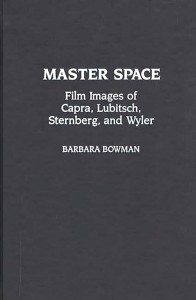
Master Space
Film Images of Capra, Lubitsch, Sternberg, and Wyler


 (0 vote)
Average rating:
| 0 | rating |  = We can do without = We can do without |
| 0 | rating |  = Good book = Good book |
| 0 | rating |  = Excellent book = Excellent book |
| 0 | rating |  = Unique / a reference = Unique / a reference |
Your rating: -
Book Presentation:
This is a unique study of the use of cinematic space by four important directors in American cinema from the 1930s to the 1960s: Frank Capra, Ernst Lubitsch, Josef von Sternberg, and William Wyler. Barbara Bowman examines each of their distinctive styles and diverse backgrounds and shows how these unique visual styles complement each other--representing the best in classic American cinema, from Ninotchka and Shanghai Express to Best Years of Our Lives to It's a Wonderful Life.
These great directors viewed space not as simple emptiness, nor as something to be manipulated pragmatically, but as a frame or palette in which to work. Their arrangements of cinematic space become not just visually recurrent techniques, but aesthetic touchstones that alert spectators to the narrative shape of the film and invite the spectator to have a more self-conscious relation to the film. Bowman explains how Capra's challenge was to take what is spatially familiar, like James Stewart's or Gary Cooper's neighborhood or small town, and defamiliarize it enough so that we see it for the first time. Lubitsch's creation of film space relies on the indirection so apparent in his scripts by Samuel Raphaelson; he depends on what the spectator cannot yet see or only anticipates, relying upon our imaginations, especially our potential lasciviousness. Sternberg's veiled shots of Marlene Dietrich and others convey a very basic skepticism about human capacity for both sight and insight, and Wyler emotionalizes his films's space by having characters like Bette Davis confront each other in triangular groups or by double framing his figures with architectural second frames. Each director approached film space with his own singular style, but all four techniques shared a common purpose to explain characters or to teach the spectator to see more intensely.
About the Author:
BARBARA BOWMAN is Director of the Humanities Division and Professor of English at Illinois Wesleyan University, Bloomington, Illinois.
Press Reviews:
?Unlike many current scholarly books on film, Master Space is not overwhelmed by theorizing: Bowman scrutinizes several major films by four "master" directors (Frank Capra, Ernst Lubitsch, Josef von Sternberg and William Wyler), not to illustrate preconceived theories, but in a spirit of inquiry. Her questions are penetrating, even though few of them are fully answered. She speculates on the impact of their immigrant experiences on the four directors' works; but she primarily explores distinctive uses of "space," by which she seems to mean what is sometimes called mise-en-scene in the films directed by Capra, Lubitsch, Sternberg, and Wyler during Hollywod's Golden Age. Her analyses of specific works, always based on careful observations of actual films, are frequently stimulating; some readers may even be prompted to re-view particular movies to check Bowman's vision. Includes brief biographies and filmographies of all four directors and a useful bibliography. All levels.?-Choice
"Unlike many current scholarly books on film, Master Space is not overwhelmed by theorizing: Bowman scrutinizes several major films by four "master" directors (Frank Capra, Ernst Lubitsch, Josef von Sternberg and William Wyler), not to illustrate preconceived theories, but in a spirit of inquiry. Her questions are penetrating, even though few of them are fully answered. She speculates on the impact of their immigrant experiences on the four directors' works; but she primarily explores distinctive uses of "space," by which she seems to mean what is sometimes called mise-en-scene in the films directed by Capra, Lubitsch, Sternberg, and Wyler during Hollywod's Golden Age. Her analyses of specific works, always based on careful observations of actual films, are frequently stimulating; some readers may even be prompted to re-view particular movies to check Bowman's vision. Includes brief biographies and filmographies of all four directors and a useful bibliography. All levels."-Choice
See the publisher website: Praeger
See the complete filmography of Frank Capra on the website: IMDB ...
> On a related topic:
Romantic Comedy in Hollywood (1998)
From Lubitsch to Sturges
by James Harvey
Subject: Genre > Comedy/Humor
Five Came Back (2014)
A Story of Hollywood and the Second World War
by Mark Harris
Subject: Director > John Ford, William Wyler, John Huston, Frank Capra, George Stevens
Conversations with the Great Moviemakers of Hollywood's Golden Age (2006)
At the American Film Institute
Dir. George Stevens Jr.
Subject: Director
At Home in the Whedonverse (2017)
Essays on Domestic Place, Space and Life
Dir. Juliette C. Kitchens
Subject: Director > Joss Whedon
 Back
Back