


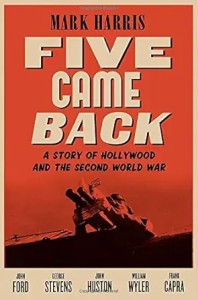
Five Came Back
A Story of Hollywood and the Second World War
de Mark Harris


 (0 vote)
Moyenne des votes :
| 0 | vote |  = On peut s'en passer = On peut s'en passer |
| 0 | vote |  = Bon livre = Bon livre |
| 0 | vote |  = Excellent livre = Excellent livre |
| 0 | vote |  = Unique / une référence = Unique / une référence |
Votre vote : -
Description de l'ouvrage:
The extraordinary wartime experience of five of Hollywood's most legendary directors, all of whom put their stamp on World War II and were changed forever by it
In Pictures at a Revolution, Mark Harris turned the story of the five movies nominated for Best Picture in 1967 into a landmark work of cultural history about the transformation of an art form and the larger social shift it signified. In Five Came Back, he gives us something even more remarkable: the untold story of how Hollywood changed World War II, and how World War II changed Hollywood, through the director’s lens.
It is little remembered now, but in prewar America, Hollywood’s relationship with Washington was decidedly tense. Investigations into corruption and racketeering were multiplying, and hanging in the air was the insinuation that the business was too foreign, too Jewish, too “un-American” in its values and causes. Could an industry with such a powerful influence on America’s collective mindset really be left in the hands of this crew?
When war came, the propaganda effort to win the hearts and minds of American soldiers and civilians was absolutely vital. Nothing else had the power of film to educate and inspire. But the government was not remotely equipped to harness it—so FDR and the military had little choice but to turn to Hollywood for help. In an unprecedented move, the whole business was farmed out to a handful of Hollywood’s most acclaimed film directors, accompanied by a creative freedom over film-making in combat zones that no one had ever had before or would ever have again.
The effort was dominated by five directing legends: John Ford, William Wyler, John Huston, Frank Capra, and George Stevens. They were complicated, competitive men, gifted and flawed in equal measure, and they didn’t always get along, with each other or with their military supervisors. But between them they were on the scene of almost every major moment of America’s war and in every branch of service—army, navy, and air force, Atlantic and Pacific; from Midway to North Africa; from Normandy to the fall of Paris and the liberation of the Nazi death camps. In the end, though none of them emerged unscarred, they produced a body of work that was essential to how Americans perceived the war, and still do.
The product of five years of original archival research, Five Came Back is an epic achievement, providing a revelatory new understanding of Hollywood’s role in the war through the life and work of five men who chose to go, and who came back.
À propos de l'auteur :
Mark Harris is the author of Pictures at a Revolution: Five Movies and the Birth of the New Hollywood, which was a New York Times notable book of the year and was named one of the ten best nonfiction books of the decade by Salon. An editor at large at Entertainment Weekly, a columnist for Grantland, and a contributing editor at New York Magazine, he has written about pop culture and film history for many other publications, including The New York Times, The Washington Post, Time, and GQ. A graduate of Yale University, Harris lives in New York City with his husband, Tony Kushner.
Revue de Presse:
The Wall Street Journal:
"Mr. Harris has a huge story to tell, and he does so brilliantly, maintaining suspense in a narrative whose basic outcome will be known ahead of time. Five Came Back is packed with true stories that, according to the proverb, are stranger than fiction. Mr. Harris's story of five particular directors at one particular moment of history tells us much about the motion-picture industry, about the nature of filmmaking and, more generally, about the relation of art to the larger demands of society. Although Five Came Back at first seems to be chronicling a collective enterprise, it turns out to be an inspirational, if cautionary, tale of the triumph of the individual over the collective, of personal vision over groupthink, and ultimately of art over propaganda."
The New York Times:
"A tough-minded, information-packed and irresistibly readable work of movie-minded cultural criticism. Like the best World War II films, it highlights marquee names in a familiar plot to explore some serious issues: the human cost of military service, the hypnotic power of cinema and the tension between artistic integrity and the exigencies of war."
Leonard Maltin:
"In addition to being a prodigious researcher and a knowledgeable film buff, Harris is a graceful writer whose prose brings the world of wartime, at home and abroad, to vivid life on every page. I tore through this hefty book as if it were a novel and can’t recommend it highly enough."
The Washington Post:
"Five Came Back, by Mark Harris, has all the elements of a good movie: fascinating characters, challenges, conflicts and intense action. This is Harris’s second brilliant book about movies. Both books demonstrate meticulous research and exceptional skill at telling intersecting and overlapping stories with clarity and power. Five Came Back enables us to watch the films of Ford, Capra, Wyler, Huston and Stevens with new insight."
The New Yorker:
"A splendidly written narrative."
San Francisco Chronicle:
"Can't-put-it-down history of World War II propaganda film."
The Los Angeles Times:
"Meticulously researched, page-turning."
David Thompson, The New Republic:
"I recommend this book for its narrative sweep, its revelation of character, and for the many ironies that attend the idea of ‘documentary.’"
Cleveland Plain Dealer:
"Mark Harris writes the old-fashioned way. His books are not quick and slick but meticulous. Definitive. In these lush, informative pages, Harris indeed reaffirms his commitment to writing the old-fashioned way, the way that evinces profound respect for his craft, his material and his readers."
Booklist (starred):
"It’s hardly news that the movies affect and are affected by the broader canvas of popular culture and world history, but Harris—perhaps more successfully than any other writer, past or present—manages to find in that symbiotic relationship the stuff of great stories. Every chapter contains small, priceless nuggets of movie history, and nearly every page offers an example of Harris’ ability to capture the essence of a person or an event in a few, perfectly chosen words. Narrative nonfiction that is as gloriously readable as it is unfailingly informative."
Kirkus Reviews:
"A comprehensive, clear-eyed look at the careers of five legendary directors who put their Hollywood lives on freeze-frame while they went off to fight in the only ways they knew how. As riveting and revealing as a film by an Oscar winner."
Publishers Weekly:
"Insightful. Harris pens superb exegeses of the ideological currents coursing through this most political of cinematic eras, and in the arcs of his vividly drawn protagonists…we see Hollywood abandoning sentimental make-believe to confront the starkest realities."
Library Journal:
"Harris surpasses previous scholarship on the directors who are the focus here… This well-researched book is essential for both film enthusiasts and World War II aficionados."
Voir le site internet de l'éditeur Penguin Press
Voir la filmographie complète de John Ford sur le site IMDB ...
> Du même auteur :

Pictures at a Revolution (2009)
Five Movies and the Birth of the New Hollywood
de Mark Harris
Sujet : Countries > United States
> Sur un thème proche :
Conversations with the Great Moviemakers of Hollywood's Golden Age (2006)
At the American Film Institute
Dir. George Stevens Jr.
Sujet : Director
Wartime cinema, Englishness and propaganda (2025)
Michael Powell and the ‘Pressburger Touch'
Sujet : Director > Michael Powell, Emeric Pressburger

Hollywood's Unofficial Film Corps (2025)
American Jewish Moviemakers and the War Effort
Sujet : Countries > United States
Continental Films (2022)
French Cinema Under German Control
de Christine Leteux et Bertrand Taverneir
Sujet : History of Cinema
Hollywood Victory (2021)
The Movies, Stars, and Stories of World War II
Hollywood Hates Hitler! (2020)
Jew-Baiting, Anti-Nazism, and the Senate Investigation Into Warmongering in Motion Pictures
Sujet : History of Cinema

Front Lines of Community (2020)
Hollywood Between War and Democracy
Promises of Citizenship (2019)
Film Recruitment of African Americans in World War II
Sujet : History of Cinema
 Retour

