


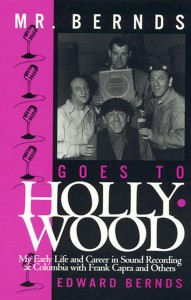
Mr. Bernds Goes to Hollywood


 (0 vote)
Average rating:
| 0 | rating |  = We can do without = We can do without |
| 0 | rating |  = Good book = Good book |
| 0 | rating |  = Excellent book = Excellent book |
| 0 | rating |  = Unique / a reference = Unique / a reference |
Your rating: -
Book Presentation:
Edward Bernds came to Hollywood in 1928 to help United Artists make the transition to sound. He worked with some of the most notable directors in Hollywood including Frank Capra, Leo McCarey, and Howard Hawks. Though Bernds loved sound work, he had higher aspirations, and hoped to become a writer and director. His first breakthrough came during the mid-1940s on Columbia shorts starring the Three Stooges. Bernds worked with Moe, Larry, Curly, Shemp, and company for over twenty years as the Stooges' favorite director. A second breakthrough came when he wrote and directed feature length films, among them the science fiction classics: World Without End, Return of the Fly, Spacemaster X7, and Zsa-zsa Gabor's Queen of Outer Space. Edward Bernds witnessed all of the profound changes that Hollywood underwent from the advent of sound to the start of the Easy Rider era. Fortunately for students and fans of film, he tells his story in this fascinating and vivid account of his life in Hollywood.
About the Author:
Edward Bernds still lives outside of Hollywood, California. He no longer makes movies, but writes about them. He has written several published articles on American film. On February 9, 1998, Bernds was honored by the National Board of Review with its Lifetime Achievement Award for Film Technology.
Press Reviews:
I love the detail...it makes me feel as if I'm there, watching it happen, and that's an exciting feeling. (Leonard Maltin)
Bernds pictures of major figures are insightful and will be quoted, but just as important are his thumbnail sketches of crew members... you get a good idea what Hollywood was like, both in and out of the studios. It certainly stands on its own as a unique memoir... (Movie Collector's World)
That clear-eyed quality that you have, with no padding and no waffle, gives one the most vivid idea of what it was like to be there. (Brownlow, Kevin)
See the publisher website: Scarecrow Press
See the complete filmography of Edward Bernds on the website: IMDB ...
> On a related topic:
Defining Cinema (2024)
Rouben Mamoulian and Hollywood Film Style, 1929-1957
Subject: Director > Rouben Mamoulian
Music and Sound in the Worlds of Michel Gondry (2022)
Subject: Director > Michel Gondry
Andrei Tarkovsky's Sounding Cinema (2019)
Music and Meaning from Solaris to The Sacrifice
Subject: Director > Andrei Tarkovsky

Godard and Sound (2018)
Acoustic Innovation in the Late Films of Jean-Luc Godard
Subject: Director > Jean-Luc Godard

Sonatas, Screams, and Silence (2015)
Music and Sound in the Films of Ingmar Bergman
by Alexis Luko
Subject: Director > Ingmar Bergman
Robert Altman's Soundtracks (2014)
Film, Music, and Sound from M*A*S*H to A Prairie Home Companion
Subject: Director > Robert Altman
Chaplin in the Sound Era (2009)
An Analysis of the Seven Talkies
by Eric L. Flom
Subject: Director > Charlie Chaplin
Literature and Sound Film in Mid-Century Britain (2025)
Subject: Countries > Great Britain
 Back
Back

