


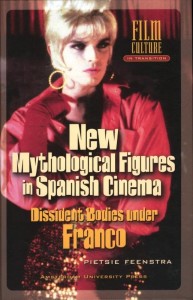
New Mythological Figures in Spanish Cinema
Dissident Bodies under Franco


 (0 vote)
Moyenne des votes :
| 0 | vote |  = On peut s'en passer = On peut s'en passer |
| 0 | vote |  = Bon livre = Bon livre |
| 0 | vote |  = Excellent livre = Excellent livre |
| 0 | vote |  = Unique / une référence = Unique / une référence |
Votre vote : -
Description de l'ouvrage:
After General Francisco Franco died in 1975, Spanish cinema was bursting at the seams. Many film directors broke free from the ancient taboos which had reigned under Franco’s dictatorship, introducing characters who transgressed the traditional borders of social, cultural, and sexual identities. The women, homosexuals, transsexuals, and delinquents who were considered lost, dissonant bodies under Franco’s rule became the new protagonists of Spanish cinema.
“Here is a ‘book of passion’ on the metamorphoses of post-Francoist Spain as it catapulted into the contemporary world (1975–95). It is a book that questions the power of myths expressed through passionate bodies, in particular bodies who for too long were marginalized in traditional societies.” —Michèle Lagny, Université de Sorbonne Nouvelle Paris III
À propos de l'auteur :
Pietsie Feenstra lectures at the Sorbonne in Paris, in the Department of Film Studies.
Voir le site internet de l'éditeur Amsterdam University Press
> Sur un thème proche :
Religion and Spanish Film (2014)
Luis Buñuel, The Franco Era, and Contemporary Directors

French and Spanish Queer Film (2016)
Audiences, Communities and Cultural Exchange
de Chris Perriam et Darren Waldron
Volatile Whiteness (2025)
Race, Cinema, and Europeanization in Spain

Spanish Meta-Art and Contemporary Cinema (2025)
Mirrors to the Unconscious
 Retour

