


Rhetoric, Inc.
Ford's Filmmaking and the Rise of Corporatism

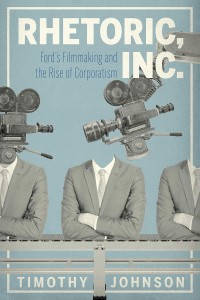

 (0 vote)
Average rating:
| 0 | rating |  = We can do without = We can do without |
| 0 | rating |  = Good book = Good book |
| 0 | rating |  = Excellent book = Excellent book |
| 0 | rating |  = Unique / a reference = Unique / a reference |
Your rating: -
Book Presentation:
In 1914, the Ford Motor Company opened its Motion Picture Laboratory, an in-house operation that produced motion pictures to educate its workforce and promote its products. Just six years later, Ford films had found their way into schools and newsreels, travelogues, and even feature films in theaters across the country. It is estimated that by 1961, the company’s movies had captured an audience of sixty-four million people.
This study of Ford’s corporate film program traces its growth and rise in prominence in corporate America. Drawing on nearly three hundred hours of material produced between 1914 and 1954, Timothy Johnson chronicles the history of Ford’s filmmaking campaign and analyzes selected films, visual and narrative techniques, and genres. He shows how what began as a narrow educational initiative grew into a global marketing strategy that presented a vision not just of Ford or corporate culture but of American life more broadly. In these films, Johnson uncovers a powerful rhetoric that Ford used to influence American labor, corporate style, production practices, road building, suburbanization, and consumer culture. The company’s early and continued success led other corporations to adopt similar programs.
Persuasive and thoroughly researched, Rhetoric, Inc. documents the role that imagery and messaging played in the formation of the modern American corporation and provides a glimpse into the cultural turn to the economy as a source of entertainment, value, and meaning.
About the Author:
Timothy Johnson is Associate Professor of English at the University of Louisville.
Press Reviews:
"This book does important work by advancing a theory of how society may be organized around terms, values, images, and ways of thinking promulgated by corporations. It makes a valuable contribution to communication and rhetorical theory, to film studies, and even to economics."
―Barry Brummett, author of Rhetoric of Machine Aesthetics
"This book brings together a set of literatures that, taken together in service of the case study at hand, offer a fascinating perspective on the relationship between rhetoric, film, corporatization, and hegemony. The central concept―incorporational rhetoric―will undoubtedly be useful to a wide range of scholars studying consumerism and commercial discourse, and rhetoric writ large."
―Christine Harold, author of OurSpace: Resisting the Corporate Control of Culture
> On a related topic:

Invasion USA (2017)
Essays on Anti-Communist Movies of the 1950s and 1960s
Dir. David J. Hogan
Subject: Sociology

Bullying in Popular Culture (2015)
Essays on Film, Television and Novels
Dir. Abigail G. Scheg
Subject: Sociology

Fictions Inc. (2014)
The Corporation in Postmodern Fiction, Film, and Popular Culture
by Ralph Clare
Subject: Sociology
The Metropolitan Police and the British Film Industry, 1919-1956 (2023)
Public Relations, Collaboration and Control
by Alex Rock
Subject: Countries > Great Britain
Duck and Cover (2011)
Civil Defense Images in Film and Television from the Cold War to 9/11
Subject: Countries > United States
Feminist Visions (2026)
Tracing Feminist Epistemologies in Contemporary Film and Television
Dir. Hélène Charlery and Cristelle Maury
Subject: Sociology
Unsuitable Film and Video Audiences (2026)
Underage Viewing Memories and Practices in 1980s United Kingdom
by Peter Turner
Subject: Sociology
Displacement of (M)others in Twenty-First-Century US Films (2026)
Impact on Maternal Identities of "Other" Subjectivities
Subject: Sociology
 Back
Back

