


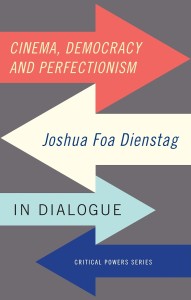
Cinema, democracy and perfectionism
Joshua Foa Dienstag in dialogue
Edited by Joshua Foa Dienstag


 (0 vote)
Average rating:
| 0 | rating |  = We can do without = We can do without |
| 0 | rating |  = Good book = Good book |
| 0 | rating |  = Excellent book = Excellent book |
| 0 | rating |  = Unique / a reference = Unique / a reference |
Your rating: -
Book Presentation:
In the lead essay for this volume, Joshua Foa Dienstag engages in a critical encounter with the work of Stanley Cavell on cinema, focusing skeptical attention on the claims made for the contribution of cinema to the ethical character of democratic life.
In this debate, Dienstag mirrors the celebrated dialogue between Rousseau and Jean D'Alembert on theatre, casting Cavell as D'Alembert in his view that we can learn to become better citizens and better people by observing a staged representation of human life, with Dienstag arguing, with Rousseau, that this misunderstands the relationship between original and copy, even more so in the medium of film than in the medium of theatre.
Dienstag's provocative and stylish essay is debated by an exceptional group of interlocutors comprising Clare Woodford, Tracy B. Strong, Margaret Kohn, Davide Panagia and Thomas Dumm. The volume closes with a robust response from Dienstag to his critics.
An electronic edition of this book is freely available under a Creative Commons (CC BY-NC-ND) licence.
About the Author:
Joshua Foa Dienstag is Professor of Political Science and Professor of Law at University of California Los Angeles
Press Reviews:
"A learned, thoughtful, and very wide-ranging reflection on the aesthetics and ontology of film, the place and role of erotic desire in democratic life, the limitations of political optimism regarding that place and role, and the limitations of Stanley Cavell's account of that place and role."
Andrew Norris, University of California, Santa Barbara
> From the same author:
> On a related topic:
How Popular Culture Destroys Our Political Imagination (2024)
Capitalism and Its Alternatives in Film and Television
Subject: Sociology
Transnationalism and Imperialism (2022)
Endurance of the Global Western Film
Dir. Hervé Mayer and David Roche
Subject: Sociology

The United States Constitution in Film (2020)
Part of Our National Culture
by Eric T. Kasper and Quentin D. Vieregge
Subject: Sociology
Social Life in the Movies (2020)
How Hollywood Imagines War, Schools, Romance, Aging, and Social Inequality
Subject: Sociology
Movies, Myth, and the National Security State (2016)
by Alex Macleod, Dan O’Meara, Frédérick Gagnon and David Grondin
Subject: Sociology
Myth in the Modern World (2014)
Essays on Intersections with Ideology and Culture
Dir. David Whitt and John Perlich
Subject: Sociology
 Back
Back

