


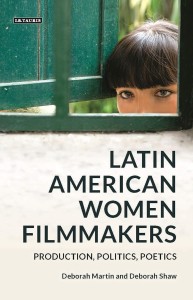
Latin American Women Filmmakers
Production, Politics, Poetics
Sous la direction de Deborah Martin


 (0 vote)
Moyenne des votes :
| 0 | vote |  = On peut s'en passer = On peut s'en passer |
| 0 | vote |  = Bon livre = Bon livre |
| 0 | vote |  = Excellent livre = Excellent livre |
| 0 | vote |  = Unique / une référence = Unique / une référence |
Votre vote : -
Description de l'ouvrage:
Latin American women filmmakers have achieved unprecedented international prominence in recent years. Notably political in their approach, figures such as Lucrecia Martel, Claudia Llosa and Bertha Navarro have created innovative and often challenging films, enjoying global acclaim from critics and festival audiences alike. They undeniably mark a 'moment' for Latin American cinema.Bringing together distinguished scholars in the field - and prefaced by B. Ruby Rich - this is a much-needed account and analysis of the rise of female-led film in Latin America. Chapters detail the collaboration that characterises Latin American women's filmmaking - in many ways distinct from the largely 'Third Cinema' auteurism from the region - as well as the transnational production contexts, unique aesthetics and socio-political landscape of the key industry figures. Through close attention to the particular features of national film cultures, from women's documentary filmmaking in Chile to comedic critique in Brazil, and from US Latina screen culture to the burgeoning popularity of Peruvian film, this timely study demonstrates the remarkable possibilities for film in the region.
This book will allow scholars and students of Latin American cinema and culture, as well as industry professionals, a deeper understanding of the emergence and impact of the filmmakers and their work, which has particular relevance for contemporary debates on feminism.
À propos de l'auteur :
Lúcia Nagib is Professor of Film and Director of the Centre for Film Aesthetics and Cultures (CFAC) at the University of Reading. Her research has focused, among other subjects, on polycentric approaches to world cinema, new waves and new cinemas, cinematic realism and intermediality. She is the author of World Cinema and the Ethics of Realism (Continuum, 2011), Brazil on Screen: Cinema Novo, New Cinema, Utopia (I.B. Tauris, 2007), The Brazilian Film Revival: Interviews with 90 Filmmakers of the 90s (Editora 34, 2002), Born of the Ashes: The Auteur and the Individual in Oshima's Films (Edusp, 1995), Around the Japanese Nouvelle Vague (Editora da Unicamp, 1993) and Werner Herzog: Film as Reality (EstaçãoLiberdade, 1991). She is the editor of Impure Cinema: Intermedial and Intercultural Approaches to Film (with Anne Jerslev, 2013), Theorizing World Cinema (with Chris Perriam and Rajinder Dudrah, I.B. Tauris, 2011), Realism and the Audiovisual Media (with Cecília Mello, Palgrave, 2009), The New Brazilian Cinema (I.B. Tauris, 2003), Master Mizoguchi (Navegar, 1990) and Ozu (Marco Zero, 1990).Deborah Shaw is Professor of Film and Screen Studies at the University of Portsmouth, UK. She is the founding co-editor of the journal Transnational Cinemas (Now Transnational Screens), and her books include Contemporary Latin American Cinema: Ten Key Films (2003), The Three Amigos: The Transnational Filmmaking of Guillermo del Toro, Alejandro González Iñárritu, and Alfonso Cuarón (2013), The Transnational Fantasies of Guillermo del Toro (co-edited with Ann Davies and Dolores Tierney, 2014), and Latin American Women Filmmakers: Production, Politics, Poetics (co-edited with Deborah Martin 2017).Julian Ross is a University Lecturer at the Centre for the Arts in Society.
Revue de Presse:
"This exciting collection balances contextual analysis with close attention to individual films and the careers of more and less visible women working in different industry roles. A major contribution to not only film studies but also to current and future thinking about women’s cultural production in Latin America." (Claire Williams, University of Oxford)
"Focusing on the cinemas of Argentina, Brazil, Chile, Mexico, Peru, Venezuela, and the Hispanic US, the essays collected here are brilliant advocates for filmmaking by Latin American women, a timely reminder that the personal is still political." (Andrea Noble, Durham University)
‘Provides a panorama of film, including documentaries, produced and/or directed by women from Brazil, Venezuela, Peru, Chile, and Argentina along with Hispanic women in the US… Recommended. Upper-division undergraduates through faculty.’
(CHOICE)
> Livres ayant un titre identique ou proche :
Latin American Women Filmmakers (2017)
Social and Cultural Perspectives
Sujet : Countries > United States
> Du même auteur :
The Child in Contemporary Latin American Cinema (2019)
Sujet : Countries > Latin America
> Sur un thème proche :
Latin American Women Filmmakers (2017)
Social and Cultural Perspectives
Sujet : Countries > United States

Directory of World Cinema / Latin America (2013)
Dir. Isabel Maurer Queipo
Sujet : Countries > Latin America
Cinema and Social Change in Latin America (1986)
Conversations With Filmmakers
Dir. Julianne Burton
Sujet : Countries > Latin America

Directory of World Cinema / Brazil (2014)
Dir. Natália Pinazza et Louis Bayman

 Retour