


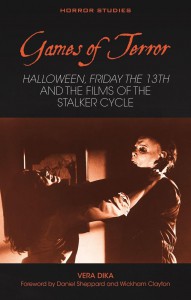
Games of Terror
"Halloween," "Friday the 13th" and the Films of the "Stalker Cycle"
by Vera Dika


 (0 vote)
Average rating:
| 0 | rating |  = We can do without = We can do without |
| 0 | rating |  = Good book = Good book |
| 0 | rating |  = Excellent book = Excellent book |
| 0 | rating |  = Unique / a reference = Unique / a reference |
Your rating: -
Book Presentation:
A first-of-its-kind study of the “stalker” subgenre of slasher films.
From 1978 to 1981 there was a proliferation of horror films entering the American film market. Among this group of films, one narrative formula proved dominant, both in its commercial profitability and in its ability to engender copies and sequels—what has come to be known as slasher films. Games of Terror is the first study to isolate a smaller group of films, within the slasher genre, what Vera Dika identifies as the “stalker” film. These include such movies as Halloween (1978), Friday the 13th (1980), Prom Night (1980), Terror Train (1980), and My Bloody Valentine (1981). As Dika shows, the distinguishing characteristic of the stalker film lies in its representation of the major character: the killer. Kept primarily offscreen for the duration of the film, the killer is usually made knowable by a distinctive shot or series of shots.
In this book, stalker films are studied as a group, not as individualistic products of a specific author, and are approached using an interdisciplinary method. Games of Terror concludes that the stalker film satisfies its audience on several levels: it functions simultaneously as a cinematic game, a psychosexual titillation, and a modern-day myth. In its latter function, the Stalker film serves as a system of communication, explaining an ongoing cultural conflict to its predominantly young (teenage) audience.
About the Author:
Vera Dika is associate professor of cinema studies at New Jersey City University.
> From the same author:
Recycled Culture in Contemporary Art and Film (2003)
The Uses of Nostalgia
by Vera Dika
Subject: Genre > Experimental
> On a related topic:


The Cinematic Boogeyman (2024)
From the Fairytale to the Slasher Film

Slasher Films (2009)
An International Filmography, 1960 through 2001

Ad Nauseam (2026)
Newsprint Nightmares from the '70s and '80s
 Back
Back

