

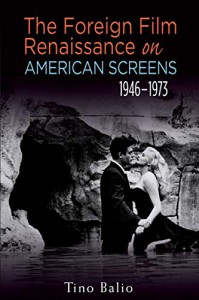
The Foreign Film Renaissance on American Screens
1946-1973
by Tino Balio


 (0 vote)
Average rating:
| 0 | rating |  = We can do without = We can do without |
| 0 | rating |  = Good book = Good book |
| 0 | rating |  = Excellent book = Excellent book |
| 0 | rating |  = Unique / a reference = Unique / a reference |
Your rating: -
Book Presentation:
“Balio revisits the most exciting period in the history of world cinema, reminding us how movies suddenly, briefly became a vital force in modern intellectual life.”
—Richard B. Jewell, author of The Golden Age of Cinema: Hollywood, 1929–1945
Largely shut out of American theaters since the 1920s, foreign films such as Open City, Bicycle Thief, Rashomon, The Seventh Seal, Breathless, La Dolce Vita, and L’Avventura played after World War II in a growing number of art houses around the country and created a small but influential art film market devoted to the acquisition, distribution, and exhibition of foreign-language and English-language films produced abroad. Nurtured by successive waves of imports from Italy, Great Britain, France, Sweden, Japan, and the Soviet Bloc, the renaissance was kick-started by independent distributors working out of New York; by the 1960s, however, the market had been subsumed by Hollywood.
From Roberto Rossellini’s Open City in 1946 to Bernardo Bertolucci’s Last Tango in Paris in 1973, Tino Balio tracks the critical reception in the press of such filmmakers as François Truffaut, Jean-Luc Godard, Federico Fellini, Michelangelo Antonioni, Tony Richardson, Ingmar Bergman, Akira Kurosawa, Luis Buñuel, Satyajit Ray, and Milos Forman. Their releases paled in comparison to Hollywood fare at the box office, but their impact on American film culture was enormous. The reception accorded to art house cinema attacked motion picture censorship, promoted the director as auteur, and celebrated film as an international art. Championing the cause was the new “cinephile” generation, which was mostly made up of college students under thirty.
The fashion for foreign films depended in part on their frankness about sex. When Hollywood abolished the Production Code in the late 1960s, American-made films began to treat adult themes with maturity and candor. In this new environment, foreign films lost their cachet and the art film market went into decline.
About the Author:
Tino Balio is professor emeritus of film in the Department of Communication Arts at the University of Wisconsin–Madison and former director of the Wisconsin Center for Film and Theater Research. He is author of United Artists, Volume 1, 1919–1950 and United Artists, Volume 2, 1951–1978 as well as Grand Design: Hollywood as Modern Business Enterprise, 1930–1939. He is editor of The American Film Industry and Hollywood in the Age of Television.
> From the same author:
United Artists (2020)
by Peter Kramer, Gary Needham, Yannis Tzioumakis and Tino Balio
Subject: Studio > United Artists
United Artists (2009)
Volume 1: 1919-1950 - The Company Built by the Stars
by Tino Balio
Subject: Studio > United Artists
United Artists (2009)
Volume 2: 1951-1978 - The Company That Changed the Film Industry
by Tino Balio
Subject: Studio > United Artists
Grand Design, 1930–1939 (1996)
History of American Cinema vol.5
by Tino Balio
Subject: History of Cinema
United Artists (1987)
The Company that Changed the Film Industry
by Tino Balio
Subject: Studio > United Artists
> On a related topic:
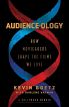
Audience-ology (2022)
How Moviegoers Shape the Films We Love
by Kevin Goetz and Darlene Hayman
Subject: Sociology
Off to the Pictures (2016)
Cinemagoing, Women's Writing and Movie Culture in Interwar Britain
by Lisa Stead
Subject: Sociology
Watching Films (2013)
New Perspectives on Movie-Going, Exhibition and Reception
Dir. Albert Moran and Karina Aveyard
Subject: Sociology
 Back
Back

