


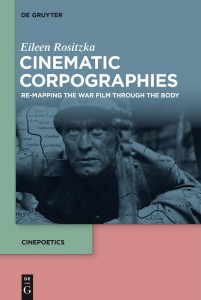
Cinematic Corpographies
Re-Mapping the War Film Through the Body


 (0 vote)
Average rating:
| 0 | rating |  = We can do without = We can do without |
| 0 | rating |  = Good book = Good book |
| 0 | rating |  = Excellent book = Excellent book |
| 0 | rating |  = Unique / a reference = Unique / a reference |
Your rating: -
Book Presentation:
Writing on the relationship between war and cinema has largely been dominated by an emphasis on optics and weaponised vision. However, as this analysis of the Hollywood war film will show, a wider sensory field is powerfully evoked in this genre. Contouring war cinema as representing a somatic experience of space, the study applies a term recently developed by Derek Gregory within the theoretical framework of Critical Geography. What he calls “corpography” implies a constant re-mapping of landscape through the soldier’s body. These assumptions can be used as a connection between already established theories of cartographic film narration and ideas of (neo)phenomenological film experience, as they also entail the involvement of the spectator’s body in sensuously grasping what is staged as a mediated experience of war. While cinematic codes of war have long been oriented almost exclusively to the visual, the notion of corpography can help to reframe the concept of film genre in terms of expressive movement patterns and genre memory, avoiding reverting to the usual taxonomies of generic texts.
About the Author:
Eileen Rositzka, Freie Universität Berlin, Kolleg-Forschergruppe Cinepoetics - Poetologien audiovisueller Bilder, Berlin, Germany.
Press Reviews:
"By examining how cinematic representations of war speak so closely to our human condition, Rositzska skilfully depicts how such representations are inflected with intersubjective permutations and assumptions about the material body, gender, and even race, assumptions which can be challenged or interrogated through aesthetic, cinematic forms in order to undercut - even subvert - a predominantly visual discourse in film and media studies."
(Panayiota Chrysochou in: Punctum, 5(1): 271-273, 2019)
See the publisher website: De Gruyter
> From the same author:
Mapping the Sensible (2022)
Distribution, Inscription, Cinematic Thinking
by Erica Carter, Bettina Malcomess and Eileen Rositzka
Subject: Theory
> On a related topic:
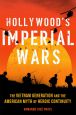
Hollywood's Imperial Wars (2024)
The Vietnam Generation and the American Myth of Heroic Continuity
The Japan/America Film Wars (2023)
World War II Propaganda and its Cultural Contexts
Dir. Abe Mark Nornes and Fukushima Yukio
City Limits (2023)
Filming Belfast, Beirut and Berlin in Troubled Times
 Back
Back

