


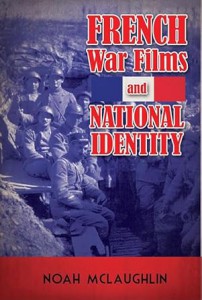
French War Films and National Identity


 (0 vote)
Average rating:
| 0 | rating |  = We can do without = We can do without |
| 0 | rating |  = Good book = Good book |
| 0 | rating |  = Excellent book = Excellent book |
| 0 | rating |  = Unique / a reference = Unique / a reference |
Your rating: -
Book Presentation:
The relationship of French national identity to its cinema is a well-established field. Yet so far, most studies have either taken a broad historical approach or focused on a particular director or period. Using various theoretical approaches, this book investigates an area that is--as of today--either ill or untreated by scholars: what is the relationship of film form to the historical and social reflections of a given work, whether they be overt or hidden? To answer this question, Noah McLaughlin conducts a close formal analysis of ten French war films from across the twentieth century. His subjects range from Abel Gance's 1919 J'Accuse to Jean-Pierre Jeunet's 2004 Un long dimanche de fiançailles and his theoretical approaches change to best examine each one. This study builds upon the broader histories of French cinema by Alan Williams (Republic of Images) and Susan Hayward (French National Cinema). Its approaches to the intersection of cinema and history owe a particular debt to Robert Rosentstone (Film on History/History on Film). There are very few book-length studies of French films about war. A close look at French cinematic explorations of war gives us a glimpse at the evolution of French identity over the course of the 20th century. It equally illuminates the story of how that nation's cinema has spent the past hundred years growing up: from its first steps leaning upon the coffee table of older literary conventions to its current adulthood as a means of cultural expression and critical exploration. One significant challenge is that the French war film is quite different from its Anglo-American counterpart. This book works through to a useful definition. It is a kind of cinematic creation that treats through form or content real armed conflicts that have significance in French history. The genre is often hybrid in nature and frequently uses metaphor. Its subjects are most often characterized collectively and in order to understand the past, psychology is emphasized over physical violence. Its plot structure is frequently non-linear and other forms over time have developed to place modernist historiography in doubt. Increasingly sophisticated, it has attained a point where historic meditations are often seamlessly but visibly integrated into both form and content. This is an important book for people interested in film studies and French studies as well as historians and historiographers.
See the publisher website: Cambria Press
> On a related topic:
Archiving the Past (2026)
Women's Film History in France, 1927–1978
Catherine Malabou and Contemporary French Literature and Film (2026)
Witnessing Plasticity
Mixed Feelings in France (2025)
White Femininity and Métissage in French Multicultural Comedy
Nouvelles Femmes (2025)
Modern Women of the French New Wave and Their Enduring Contribution to Cinema
The Cinematic Enfant Terrible (2025)
Rule Breaking Children and Teenagers in French Cinema
Looking Beyond Neoliberalism (2024)
French and Francophone Belgian Cinema and the Crisis
The Ethnographic Optic (2024)
Jean Rouch, Chris Marker, Alain Resnais, and the Turn Inward in 1960s French Cinema
Through a Nuclear Lens (2024)
France, Japan, and Cinema from Hiroshima to Fukushima
 Back
Back
