


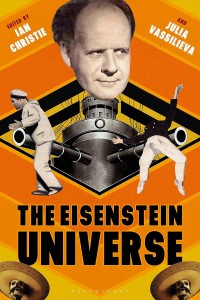
The Eisenstein Universe
Edited by Ian Christie and Julia Vassilieva


 (0 vote)
Average rating:
| 0 | rating |  = We can do without = We can do without |
| 0 | rating |  = Good book = Good book |
| 0 | rating |  = Excellent book = Excellent book |
| 0 | rating |  = Unique / a reference = Unique / a reference |
Your rating: -
Book Presentation:
Over the decades since he was first hailed by critics and filmmakers around the world, Sergei Eisenstein has assumed many identities. Originally cast as a prophet of revolution and the maestro of montage, and later seen as both a victim of and apologist for Stalin’s tyranny, the scale and impact of Eisenstein’s legacy has continued to grow. If early research on Eisenstein focused on his directorial work – from the legendary Battleship Potemkin and October to the still-controversial Ivan the Terrible – with time scholars have discovered many other aspects of his multifarious output. In recent years, multimedia exhibitions, access to his vast archive of drawings, and publication of his previously censored theoretical writings have cast Eisenstein in a new light. Deeply engaged with some of the leading thinkers and artists of his own time, Eisenstein remains a focus for many of their successors, contested as well as revered. Over half a century since his death in 1948, an ambitious treatise that he hoped would be his major legacy, Method, has finally been published. Eisenstein's lifelong search for an underlying unity that would link archaic art with film’s modernity, individuals with their historic communities, and humans as a species with the universe, may have more appeal than ever today. And among his many thwarted film projects, those set in Mexico and what were once the Soviet Central Asian republics reveal complex and still-intriguing realms of speculation. In this ground-breaking collection, sixteen international scholars explore Eisenstein’s prescient engagement with aesthetics, anthropology and psychology, his roots in diverse philosophical traditions, and his gender politics. What emerges has surprising relevance to contemporary media archaeology, intermediality, cognitive science, eco-criticism and queer studies, as well as confirming Eisenstein's prestige within present-day film and audiovisual media.
About the authors:
Ian Christie is Fellow of the British Academy and Anniversary Professor of Film and Media History at Birkbeck, University of London, UK. He co-edited the collection Eisenstein Rediscovered (1993) as well as organising a 1988 Oxford conference that preceded it. He has long been active in presenting Eisenstein's silent films with live accompaniment, and in promoting awareness of the drawings, most recently in Eisenstein on Paper: The Graphic Works (2017). Among many exhibitions, he co-curated Eisenstein: His Life and Work (Oxford, London and Manchester, 1988), and Unexpected Eisenstein (London, 2016).Julia Vassilieva is Senior Lecturer in Film and Screen Studies at Monash University, Melbourne, Australia. Her books include Narrative Psychology (2016), the co-edited Beyond the Essay Film (2020) and After Taste: Cultural Value and the Moving Image (2013), and she has published widely in film and psychology journals. She organised the symposium 'Eisenstein for the Twenty First Century' in June 2018 in Prato, Italy, and co-convened the Eisenstein International Network's first conference in October 2019 at INHA, Paris.
Press Reviews:
"This collection of essays by a collection of outstanding scholars allows the full richness of a new Eisenstein to explode out of its pages, provoking a series of new conversations that will have resonance for decades to come. It should be essential reading for any film scholar." ―Emma Widdis, Trinity College, University of Cambridge, UK
"Some of today's leading Eisenstein scholars take us on a new exploration of his cinematic world, one we thought we knew, but which turns out to be alive with possibilities. Devouring these essays--with topics ranging from Eisenstein's numerological superstitions to discussions of gender, pathos and landscape--I felt again the delight that comes from diving deeply into his films, in which art and thought constantly provoke each other, creating something bold, surprising, new." ―Anne Nesbet, author of Savage Junctures: Sergei Eisenstein and the Shape of Thinking
"This book's title is less of a hyperbole than it may seem. As a theorist, Sergei Eisenstein sought a universal law that explains art's emotional impact across cultures, media and ages. Fluent in four languages, he spent years tracing this law in wildly different areas of knowledge. As these essays show, the quest was not aimless. His writings, like his films, relied on the cognitive power of juxtaposition, collating ideas to collide them-and make some astounding discoveries. All too few of his many projects saw the light of day. This book alerts us to the power of the abandoned, the aborted, the unmade-things worth thinking through again. Eisenstein's once-compact universe, like the one we inhabit, is expanding." ―Yuri Tsivian, author of Ivan the Terrible (BFI Film Classics)
See the publisher website: Bloomsbury Academic
See the complete filmography of Sergei Eisenstein on the website: IMDB ...
> From the same authors:
What Made Cinema? (2025)
Essays on Visual Culture and Early Film
by Ian Christie
Subject: Silent Cinema
Spaces (2024)
Exploring Spatial Experiences of Representation and Reception in Screen Media
Dir. Ian Christie
Subject: Theory
Beyond the Essay Film (2020)
Subjectivity, Textuality and Technology
Dir. Julia Vassilieva and Deane Williams
Subject: Theory
Robert Paul and the Origins of British Cinema (2019)
by Ian Christie
Subject: Countries > Great Britain

The Film Factory (2015)
Russian and Soviet Cinema in Documents 1896-1939
Dir. Richard Taylor and Ian Christie
Subject: Countries > Russia / USSR
Eisenstein Rediscovered (2014)
Dir. Ian Christie and Richard Taylor
Subject: Director > Sergei Eisenstein

Smith (2014)
by Ian Christie, Martin Herbert, Kathrin Meyer and Ethan de Seife
Subject: Director > John Smith
After Taste (2013)
Cultural Value and the Moving Image
Dir. Julia Vassilieva and Constantine Verevis
Subject: Sociology
The Art of Film (2008)
John Box and Production Design
by Ian Christie
Subject: Others persons > John Box
The Cinema of Michael Powell (2005)
International perspectives on an English Filmmaker
Dir. Ian Christie and Andrew Moor
Subject: Director > Michael Powell

The Last Machine (1995)
Early Cinema and the Birth of the Modern World
by Ian Christie
Subject: Silent Cinema
Inside the Film Factory (1994)
New Approaches to Russian and Soviet Cinema
Dir. Richard Taylor and Ian Christie
Subject: Countries > Russia / USSR
> On a related topic:
An Imaginary Cinema (2024)
Sergei Eisenstein and the Unrealized Film
Subject: Director > Sergei Eisenstein
Psychoanalytic Perspectives on Sergei M. Eisenstein's Work (2023)
Cinema and Psychoanalysis in Soviet Russia
Subject: Director > Sergei Eisenstein
Dance of Values (2020)
Sergei Eisenstein's Capital Project
by Elena Vogman
Subject: Director > Sergei Eisenstein

Movement, Action, Image, Montage (2018)
Sergei Eisenstein and the Cinema in Crisis
Subject: Director > Sergei Eisenstein
V Dome Mastera. Mir Sergeya Eyzenshteyna (2018)
by Vera Rumyantseva-Kleyman
(in English and Russian)
Subject: Director > Sergei Eisenstein

Beyond the Stars (2018)
Part 1: The Boy from Riga
Dir. Sergei Eisenstein
Subject: Director > Sergei Eisenstein
Sergei M. Eisenstein (2016)
Notes for a General History of Cinema
by Sergei Eisenstein, Naum Kleiman and Antonio Somaini
Subject: Director > Sergei Eisenstein
 Back
Back

