


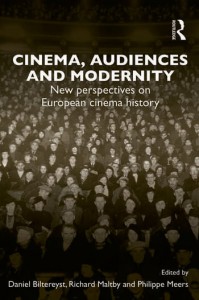
Cinema, Audiences and Modernity
New perspectives on European cinema history
Sous la direction de Daniel Biltereyst, Richard Maltby et Philippe Meers


 (0 vote)
Moyenne des votes :
| 0 | vote |  = On peut s'en passer = On peut s'en passer |
| 0 | vote |  = Bon livre = Bon livre |
| 0 | vote |  = Excellent livre = Excellent livre |
| 0 | vote |  = Unique / une référence = Unique / une référence |
Votre vote : -
Description de l'ouvrage:
This book sheds new light on the cinema and modernity debate by confronting established theories on the role of the modern cinematic experience with new empirical work on the history of the social experience of cinema-going, film audiences and film exhibition.
The book provides a wide range of research methodologies and perspectives on these matters, including:
the use of oral history methods
questionnaires
diaries
audience letters
as well as industrial, sociological and other accounts on historical film audiences.
The collection’s case studies thus provide a "how to" compendium of current methodologies for researchers and students working on film and media audiences, film and media experiences, and historical reception.
The volume is part of a ‘new cinema history’ effort within film and screen studies to look at film history not only as a history of production, textual relations or movies-as-artefacts, but rather to concentrate more on the receiving end, the social experience of cinema, and the engagement of film/cinema (history) ‘from below’. The contributions to the volume reflect upon the very different ways in which cinema has been accepted, rejected or disciplined as an agent of modernity in neighbouring parts of Europe, and how cinema-going has been promoted and regulated as a popular social practice at different times in twentieth-century European history.
À propos des auteurs :
Daniel Biltereyst is Professor in Film, Television and Cultural Studies at the Department of Communication Studies, Ghent University, Belgium, where he leads the Centre for Cinema and Media Studies (CIMS). His research on film and screen culture as sites of controversy and censorship has been published in Cultural Policy, European Journal of Cultural Studies, Historical Journal of Film, Radio and Television, Journal of Communication Inquiry, Media, Culture & Society, Northern Lights, Studies in French Cinema, Studies in Russian and Soviet Cinema. Richard Maltby is Professor of Screen Studies and Deputy Execuive Dean of the Faculty of Education, Humanities, Law and Theology at Flinders University, South Australia. He is Series Editor of Exeter Studies in Film History, and the author of over 50 articles and essays, and the lead investigator on two Australian Research Council Discovery projects examining the structure of the distribution and exhibition industry and the history of cinema audiences in Australia. Philippe Meers is an associate professor in the Department of Communication Studies at the University of Antwerp, Belgium. His publications on popular media culture and film audiences have appeared in Media, Culture and Society, The Journal of Popular Film and Television, The Bulletin, Iluminace and other journals. He is the lead investigator on The ‘Enlightened’ City-project on the history of film exhibition and film culture in Flanders and Brussels (2005-8, with Daniël Biltereyst and Marnix Beyen).
Revue de Presse:
'This volume, edited by experienced and knowledgeable scholars with international reputations, gathers together a fascinating set of essays that, taken together, illuminate the historical relationships among films, moviegoing, and modernity.
The focus of this wide-ranging work is Europe, and the justification for this focus is compelling. The bulk of historical scholarship on the experience of cinema, the social experience of moviegoing, the history of cinematic reception, and movies audiences derives from case studies in the United States, dating back to the 1970s. In the meantime, a new generation of film scholars have turned their attention to the quite different contexts within which films were shown and viewed. Exhibition and moviegoing patterns varied markedly not only between national cinemas but also within particular nations. These differences raise interesting questions about the role of religion, language, cultural difference, gender, and ethnicity in patterns of movie exhibition, distribution, reception, and attendance.
Geographic coverage is admirably broad, setting up possibilities for comparative analysis among a number of nations, regions, and locales. Similarly, the chronological coverage is broad: ranging from the early periods of film history through the post-war period.
This collection fits very well with a growing literature on the history of the experience of cinema, and it will add significantly to our knowledge base on the particularities and commonalities of European film culture as viewed from the bottom up.' Robert C. Allen, University of North Carolina at Chapel Hill
'The essays use a range of research methodologies, including oral history, to produce a 'new cinema history' that takes greater account of audience reception and that acknowledges the importance of the audience as consumers of films. (...) This provides thought-provoking insights into the relationshipos bewteen cinema and modernity in different European contexts, and the essays in this volume, of a consistently high standard, span a chronological period from 1895 to 1970. Cinema, Audiences and Modernity is essential reading for those interested in audiences, reception and the social values and cultural history of cinema in the nineteenth and twentieth century.' Helen Rajabi, European Review of History, 19(4), August 2012
'(the essays) represent an exciting stage in the disciplinary development of what the editors call 'new cinema history'. (...) This work has a sense of actuality and urgency that is remarkable given its historical nature. (The book) combine(s) careful and intelligent editing with the vibrancy of a work in progress. The pose is impeccable and the chapters resonate with each other with no jarring shifts in register. With technological changes making collaborative, scalable projects an increasingly frequent form of scholarly practice, the (book) reviewed set(s) a high standard for a field that is evidently thriving.' Maria A. Vélez-Serna, Historical Journal of Film, Radio & Television, 32(3), September 2012
'...Biltereyst, Maltby, and Meers volumes have a legitimate claim to providing perhaps the most varied comparative data available to date. In doing so, they also counter accusations of provincialism within individual studies, for they begin to establish a potentially global and transhistorical mapping of cinema exhibition.' Joe Kember, Early Popular Visual Culture
'Biltereyst, Maltby and Meers' edited collection in the end manages to expand...the boundaries of what we understand as modernity, its relationship and association to cinema; in addition, and more importantly perhaps, it stretches the historiographical map of Early European Cinema research towards territories and methodologies not yet common.' Tonia Zakakopoulou, Participations: Journal of Audience & Reception Studies
> Des mêmes auteurs :
The Screen Censorship Companion (2024)
Critical Explorations in the Control of Film and Screen Media
Dir. Daniel Biltereyst et Ernest Mathijs
Sujet : Sociology

Cinema in the Arab World (2024)
New Histories, New Approaches
Dir. Ifdal Elsaket, Daniel Biltereyst et Philippe Meers
Sujet : Countries > Middle East
New Perspectives on Early Cinema History (2024)
Concepts, Approaches, Audiences
Dir. Mario Slugan et Daniel Biltereyst
Sujet : Silent Cinema
Film, Cinema, Genre (2021)
The Steve Neale Reader
de Steve Neale, Frank Krutnik et Richard Maltby
Sujet : Genre > All Genres

Mapping Movie Magazines (2020)
Digitization, Periodicals and Cinema History
Dir. Daniel Biltereyst et Lies Van de Vijver
Sujet : On Films > Movie magazines
Moralizing Cinema (2018)
Film, Catholicism, and Power
Dir. Daniel Biltereyst et Daniela Treveri Gennari
Sujet : Sociology

Silencing Cinema (2013)
Film Censorship around the World
Dir. Daniel Biltereyst et Roel Vande Winkel
Sujet : General

'Film Europe' and 'Film America' (1999)
Cinema, Commerce and Cultural Exchange 1920-1939
Dir. Andrew Higson et Richard Maltby
Sujet : History of Cinema
> Sur un thème proche :



Europe in Upheaval (2022)
Identity in Politics, Literature and Film
Dir. Michaela Nicole Raß et Kay Wolfinger
Precarious Intimacies (2020)
The Politics of Touch in Contemporary Western European Cinema
de Maria Stehle et Beverly Weber
European Cinema and Television (2015)
Cultural Policy and Everyday Life
Dir. Ib Bondebjerg, Eva Novrup Redvall et Andrew Higson
Alternative Empires (2000)
European Modernist Cinemas and Cultures of Imperialism
The Demons of Modernity (2016)
Ingmar Bergman and European Cinema
de John Orr
Sujet : Director > Ingmar Bergman
 Retour