


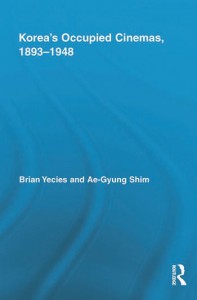
Korea's Occupied Cinemas, 1893-1948
The Untold History of the Film Industry
de Brian Yecies et Ae-Gyung Shim


 (0 vote)
Moyenne des votes :
| 0 | vote |  = On peut s'en passer = On peut s'en passer |
| 0 | vote |  = Bon livre = Bon livre |
| 0 | vote |  = Excellent livre = Excellent livre |
| 0 | vote |  = Unique / une référence = Unique / une référence |
Votre vote : -
Description de l'ouvrage:
Korea’s Occupied Cinemas, 1893-1948 compares and contrasts the development of cinema in Korea during the Japanese occupation (1910-1945) and US Army Military (1945-1948) periods within the larger context of cinemas in occupied territories. It differs from previous studies by drawing links between the arrival in Korea of modern technology and ideas, and the cultural, political and social environment, as it follows the development of exhibition, film policy, and filmmaking from 1893 to 1948. During this time, Korean filmmakers seized every opportunity to learn production techniques and practice their skills, contributing to the growth of a national cinema despite the conditions produced by their occupation by colonial and military powers. At the same time, Korea served as an important territory for the global expansion of the American and Japanese film industries, and, after the late 1930s, Koreans functioned as key figures in the co-production of propaganda films that were designed to glorify loyalty to the Japanese Empire. For these reasons, and as a result of the tensions created by divided loyalties, the history of cinema in Korea is a far more dynamic story than simply that of a national cinema struggling to develop its own narrative content and aesthetics under colonial conditions.
À propos des auteurs :
Brian Yecies is Senior Lecturer in Media and Cultural Studies at the University of Wollongong. His research focuses on film policy, the history of cinema, and the digital wave in Korea. He is a pastrecipient of prestigious research grants from the Asia Research Fund, Korea Foundation and Australia-Korea Foundation. Ae-Gyung Shim received her PhD from the University of New South Wales with the support of a Korea Foundation Fellowship for Graduate Studies. She has taught part-time in Communication and Media Studies at the University of Wollongong, and is a 2011 Korea Foundation Post-Doctorial Fellow at the Centre for Asia Pacific Social Transformation Studies.
> Des mêmes auteurs :
> Sur un thème proche :
Cinema under National Reconstruction (2024)
State Censorship and South Korea's Cold War Film Culture
Korean Cinema in Global Contexts (2022)
Post-Colonial Phantom, Blockbuster and Trans-Cinema
de Soyoung Kim
Cine-Mobility (2022)
Twentieth-Century Transformations in Korea's Film and Transportation
de Han Sang Kim
The Late and Post-Dictatorship (2025)
Cinephilia Boom and Art Houses in South Korea

The South Korean Film Industry (2024)
Dir. Junhyung Cho, Sangjoon Lee et Dal Yong Jin
 Retour

