


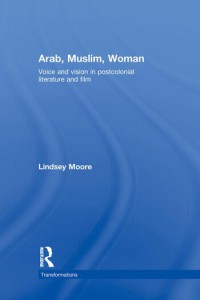
Arab, Muslim, Woman
Voice and Vision in Postcolonial Literature and Film


 (0 vote)
Average rating:
| 0 | rating |  = We can do without = We can do without |
| 0 | rating |  = Good book = Good book |
| 0 | rating |  = Excellent book = Excellent book |
| 0 | rating |  = Unique / a reference = Unique / a reference |
Your rating: -
Book Presentation:
Given a long history of representation by others, what themes and techniques do Arab Muslim women writers, filmmakers and visual artists foreground in their presentation of postcolonial experience?
Lindsey Moore’s groundbreaking book demonstrates ways in which women appropriate textual and visual modes of representation, often in cross-fertilizing ways, in challenges to Orientalist/colonialist, nationalist, Islamist, and ‘multicultural’ paradigms. She provides an accessible but theoretically-informed analysis by foregrounding tropes of vision, visibility and voice; post-nationalist melancholia and mother/daughter narratives; transformations of ‘homes and harems’; and border crossings in time, space, language, and media. In doing so, Moore moves beyond notions of speaking or looking ‘back’ to encompass a diverse feminist poetics and politics and to emphasize ethical forms of representation and reception.
Aran, Muslim, Woman is distinctive in the eclectic body of work that it brings together. Discussing Algeria, Egypt, Jordan, Lebanon, Morocco, the Palestinian territories, and Tunisia, as well as postcolonial Europe, Moore argues for better integration of Arab Muslim contexts in the postcolonial canon. In a book for readers interested in women's studies, history, literature, and visual media, we encounter work by Assia Djebar, Mona Hatoum, Fatima Mernissi, Ahlam Mosteghanemi, Nawal el Saadawi, Leila Sebbar, Zineb Sedira, Ahdaf Soueif, Moufida Tlatli, Fadwa Tuqan, and many other women.
About the Author:
Lindsey Moore is Lecturer in English at Lancaster University, where she teaches postcolonial literatures, women’s writing, and literary theory. She has published articles on representations of Arab and Muslim women and on Arab women’s writing.
See the publisher website: Routledge
> On a related topic:

Women's New Cinema in Contemporary Turkey (2025)
As If We Were Free, As If a Beautiful Life Were Possible
Subject: Countries > Middle East
Women in the Cinemas of Iran and Turkey (2021)
As Images and as Image-Makers
Subject: Countries > Middle East
Negotiating Dissidence (2017)
The Pioneering Women of Arab Documentary
Subject: Countries > Middle East
Women and Turkish Cinema (2014)
Gender Politics, Cultural Identity and Representation
by Eylem Atakav
Subject: Countries > Middle East
Feminist Visions (2026)
Tracing Feminist Epistemologies in Contemporary Film and Television
Dir. Hélène Charlery and Cristelle Maury
Subject: Sociology
The Routledge Handbook of Motherhood on Screen (2025)
Dir. Susan Liddy and Deirdre Flynn
Subject: Sociology
Working Women on Screen (2025)
Paid Labour and Fourth Wave Feminism
Dir. Ellie Tomsett, Nathalie Weidhase and Poppy Wilde
Subject: Sociology
 Back
Back

