


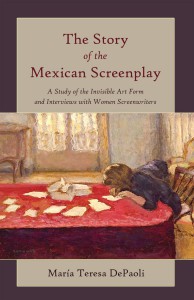
The Story of the Mexican Screenplay
A Study of the Invisible Art Form and Interviews with Women Screenwriters


 (0 vote)
Average rating:
| 0 | rating |  = We can do without = We can do without |
| 0 | rating |  = Good book = Good book |
| 0 | rating |  = Excellent book = Excellent book |
| 0 | rating |  = Unique / a reference = Unique / a reference |
Your rating: -
Book Presentation:
The Story of the Mexican Screenplay: A Study of the Invisible Art Form and Interviews with Women Screenwriters contributes to the international development of screenplay studies. While the debate on the ontology of the screenplay continues, a fact remains clear for screenwriters: the screenplay is the film’s skeleton and the main base that sustains a story told through images. Certainly, lack of visibility, including publication, distribution, and promotion, are some of the problems that the screenplay confronts, but these are not the only challenges. Traditionally, the form has been unappreciated and regarded by many as only an initial step in the complexity of film production. In this study, the author elaborates on the cultural baggage that the screenplay carries since it is text imbued with multiple signs that – for various reasons – often get lost in the process and never make it to the screen. In this context, the author touches on the concept of adaptation since it is often a key element in screenplay research.
The Story of the Mexican Screenplay focuses on a general historical investigation of the Mexican screenplay, specifically on women’s screenwriting. In addition to screenplay analysis, the interviews with women screenwriters are revealing of various cultural issues such as gender discrimination in the work place, political censorship, collective screenwriting, and collaboration among writers, and with the director. These topics explain, in part, the double marginalization of female screenwriting in Mexico.
About the Author:
María Teresa DePaoli is Associate Professor of Spanish at Kansas State University. She received her doctorate degree from Purdue University in 2001. Her research centers on Latin American literature, film, media, as well as cultural studies, and she has published numerous peer-reviewed articles. DePaoli is coeditor (with Laura Kanost) of Las guionistas: A Bilingual Anthology of Mexican Women Screenwriters (forthcoming).
See the publisher website: Peter Lang
> On a related topic:
The Woman in the Story (2017)
Writing Memorable Female Characters
by Helen Jacey
Subject: Technique > Scriptwriting
The Heart of Your Script (2026)
The Insider's Guide to Writing the Difficult Middle Section of a Screenplay
by Ted Wilkes and Phil Hughes
Subject: Technique > Scriptwriting
Games Directors Play (2026)
Tricks and Stratagems of Cinematic Storytelling
Subject: Technique > Scriptwriting
Integrated Storytelling by Design (2026)
Concepts, Principles and Methods for New Narrative Dimensions
Subject: Technique > Scriptwriting
Rem Koolhaas as Scriptwriter (2025)
OMA Architecture Script for West Berlin
Subject: Technique > Scriptwriting

Crafting Short Screenplays That Connect (2025)
Subject: Technique > Scriptwriting
Beyond the Monoplot (2025)
How to Write Unconventional Films (and Why We Should)
by Chris Neilan
Subject: Technique > Scriptwriting
Scriptnotes (2025)
A Book About Screenwriting and Things That Are Interesting to Screenwriters
by John August and Craig Mazin
Subject: Technique > Scriptwriting
 Back
Back

