


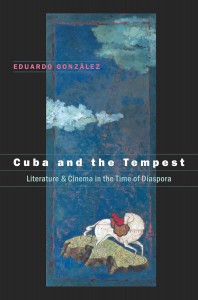
Cuba and the Tempest
Literature and Cinema in the Time of Diaspora


 (0 vote)
Average rating:
| 0 | rating |  = We can do without = We can do without |
| 0 | rating |  = Good book = Good book |
| 0 | rating |  = Excellent book = Excellent book |
| 0 | rating |  = Unique / a reference = Unique / a reference |
Your rating: -
Book Presentation:
In a unique analysis of Cuban literature inside and outside the country’s borders, Eduardo González looks closely at the work of three of the most important contemporary Cuban authors to write in the post-1959 diaspora: Guillermo Cabrera Infante (1929–2005), who left Cuba for good in 1965 and established himself in London; Antonio Benítez-Rojo (1931–2005), who settled in the United States; and Leonardo Padura Fuentes (b. 1955), who still lives and writes in Cuba.
Through the positive experiences of exile and wandering that appear in their work, these three writers exhibit what González calls “Romantic authorship,” a deep connection to the Romantic spirit of irony and complex sublimity crafted in literature by Lord Byron, Thomas De Quincey, and Samuel Taylor Coleridge. In González’s view, a writer becomes a belated Romantic by dint of exile adopted creatively with comic or tragic irony. González weaves into his analysis related cinematic elements of myth, folktale, and the grotesque that appear in the work of filmmakers such as Alfred Hitchcock and Pedro Almodóvar. Placing the three Cuban writers in conversation with artists and thinkers from British and American literature, anthropology, philosophy, psychoanalysis, and cinema, González ultimately provides a space in which Cuba and its literature, inside and outside its borders, are deprovincialized.
About the Author:
Eduardo González teaches literature and cinema at The Johns Hopkins University. He is author of three other books, including The Monstered Self: Narratives of Death and Performance in Latin American Fiction.
Press Reviews:
"Examines the island culture in the context of the greater world of literary texts . . . recommended to readers interested in literature in art."
-- "Colonial Latin American History Review"
"This is undoubtedly a major work by a major critic whose talents are unbounded and whose voice is allowed to roam freely across temporal, geographic and intellectual boundaries to places where analysis of Cuban literature has rarely ventured. It is thus a very important book and one that starts to fill a large chasm in Cuban literary studies."
-- "Caribbean Studies"
See the publisher website: University of of North Carolina Press
> On a related topic:
Fidel Between the Lines (2019)
Paranoia and Ambivalence in Late Socialist Cuban Cinema
Subject: Countries > Latin America
From Havana to Hollywood (2025)
Slave Resistance in the Cinematic Imaginary
Subject: Countries > Latin America
Sexual Diversity in Young Cuban Cinema (2024)
Subject: Countries > Latin America
The Cinema of Cuba (2021)
Contemporary Film and the Legacy of Revolution
Dir. Ann Marie Stock
Subject: Countries > Latin America
A Cuban Cinema Companion (2020)
Dir. Salvador Jiménez Murguía, Sean O'Reilly and Amanda McMenamin
Subject: Countries > Latin America
Hollywood in Havana (2019)
US Cinema and Revolutionary Nationalism in Cuba before 1959
by Megan Feeney
Subject: Countries > Latin America
National Identity in 21st-Century Cuban Cinema (2018)
Screening the Repeating Island
Subject: Countries > Latin America
Cuban Film Media, Late Socialism, and the Public Sphere (2016)
Imperfect Aesthetics
Subject: Countries > Latin America
Cuban Cinema After the Cold War (2015)
A Critical Analysis of Selected Films
Subject: Countries > Latin America
Screening Cuba (2010)
Film Criticism As Political Performance During the Cold War
by Hector Amaya
Subject: Countries > Latin America
 Back
Back

