


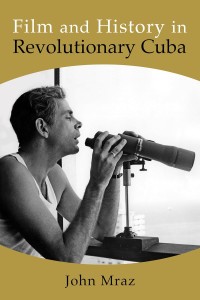
Film and History in Revolutionary Cuba
by John Mraz


 (0 vote)
Average rating:
| 0 | rating |  = We can do without |
| 0 | rating |  = Good book |
| 0 | rating |  = Excellent book |
| 0 | rating |  = Unique / a reference |
Your rating: -
Book Presentation:
An unparalleled in-depth study of Cuban revolutionary cinema.
From 1968 to 1976, energized by a postrevolutionary cultural effervescence of which cinema was the prime expression, the Cuban Film Institute made a unique, concerted effort to produce history films and to reflect on the genre. The result was twofold―a number of formally experimental, historically informed, and internationally recognized movies along with an extended discussion among the institute's cineastes about the aesthetics and ideology of their works. In Film and History in Revolutionary Cuba, world-renowned historian of visual culture John Mraz approaches these films from a dual perspective. Mraz sheds light on the context of ebullition that marked cinema of the period while analyzing fictional works such as Memories of Underdevelopment, Lucía, The Other Francisco, and The Last Supper as representations of history in both their form and their content. Such films not only offer important, powerful explorations of the past but are also deeply embedded in the history of that moment.
About the Author:
John Mraz is a Research Professor of the Instituto de Ciencias Sociales y Humanidades, Benemérita Universidad Autónoma de Puebla. He is the author of History and Modern Media: A Personal Journey and Photographing the Mexican Revolution: Commitments, Testimonies, Icons.
Press Reviews:
"An outstanding contribution to scholarship on Cuban cinema. Film and History in Revolutionary Cuba insists upon a deeply contextualized approach to understanding a corpus of highly original and internationally recognized historical films that were produced by the Cuban Film Institute (Instituto Cubano del Arte e Industria Cinematográficos, ICAIC) during the period 1968 to 1976. Mraz succeeds beautifully in recuperating the cultural effervescence of the era and deepens our appreciation for the culture of the Cuban Revolution." ― Philip Kaisary, author of From Havana to Hollywood: Slave Resistance in the Cinematic Imaginary
See the publisher website: State University of New York Press
> On a related topic:
Hollywood in Havana (2019)
US Cinema and Revolutionary Nationalism in Cuba before 1959
by Megan Feeney
Subject: Countries > Latin America
Screening Cuba (2010)
Film Criticism As Political Performance During the Cold War
by Hector Amaya
Subject: Countries > Latin America

The Cinema of Sara Gómez (2021)
Reframing Revolution
Dir. Susan Lord and María Caridad Cumaná
Subject: Director > Sara Gómez
From Havana to Hollywood (2025)
Slave Resistance in the Cinematic Imaginary
Subject: Countries > Latin America
Sexual Diversity in Young Cuban Cinema (2024)
Subject: Countries > Latin America
The Cinema of Cuba (2021)
Contemporary Film and the Legacy of Revolution
Dir. Ann Marie Stock
Subject: Countries > Latin America
A Cuban Cinema Companion (2020)
Dir. Salvador Jiménez Murguía, Sean O'Reilly and Amanda McMenamin
Subject: Countries > Latin America
Fidel Between the Lines (2019)
Paranoia and Ambivalence in Late Socialist Cuban Cinema
Subject: Countries > Latin America
National Identity in 21st-Century Cuban Cinema (2018)
Screening the Repeating Island
Subject: Countries > Latin America
Cuban Film Media, Late Socialism, and the Public Sphere (2016)
Imperfect Aesthetics
Subject: Countries > Latin America
 Back


