


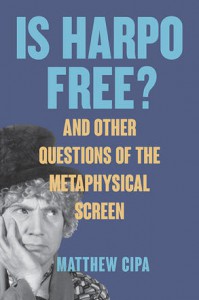
Is Harpo Free?
And Other Questions of the Metaphysical Screen (livre en anglais)
de Matthew Cipa


 (0 vote)
Moyenne des votes :
| 0 | vote |  = On peut s'en passer = On peut s'en passer |
| 0 | vote |  = Bon livre = Bon livre |
| 0 | vote |  = Excellent livre = Excellent livre |
| 0 | vote |  = Unique / une référence = Unique / une référence |
Votre vote : -
Description de l'ouvrage :
Examines how philosophical concepts like free will, personal identity, and goodness are given an artistic life in films and television programs.
Is Harpo Free? is a lively appreciation of film and television's ability to artistically explore concepts typical of philosophical metaphysics, such as free will, causality, and personal identity. Rather than using films and television programs as vehicles for philosophical arguments, the book instead celebrates the artistic ways in which they give life to various metaphysical concepts and how the artistic expression of these concepts and ideas helps us understand ourselves, the world, and our place within it. Through close analysis of a varied selection of works and their use of narrative, form, and style, Is Harpo Free? exemplifies a novel approach to appreciating the philosophical substance of films and television programs. Films and television programs discussed include A Night at the Opera; Run, Lola, Run; Shane; Harvey; Three Colours: Blue; The Americans; Dark; and Fargo.
À propos de l'auteur :
Matthew Cipa is Lecturer at the Queensland University of Technology, Australia and affiliate academic in the School of Languages and Cultures at the University of Queensland, Australia.
Revue de Presse :
"This book is an excellent introduction to metaphysical concepts in and of film, and both the clarity with which they are expressed and the deftness with which they are applied make it a very rewarding read. Cipa stretches our understanding and renews our appetite for thinking about cinema and television." — Daniel Varndell, University of Winchester
"Many colleges and graduate programs have courses in film theory, but this book is a rarity these days in that its themes are ideas so universal, and so deep, that it has a fair chance of finding an audience among nonspecialists. All it really requires of the reader is a love of film and television." — William Rothman, University of Miami
Voir le site internet de l'éditeur State University of New York Press
> Sur un thème proche :
Happiness and Tears, After Cavell (2025)
New Readings in Hollywood's Comedy of Remarriage and Melodrama of the Unknown Woman
Dir. Paul Deb
Sujet : Sociologie

Deleuze, Japanese Cinema, and the Atom Bomb (2016)
The Spectre of Impossibility
de David Deamer
Sujet : Sociologie
Cinema, democracy and perfectionism (2016)
Joshua Foa Dienstag in dialogue
Dir. Joshua Foa Dienstag
Sujet : Sociologie
 Retour


