


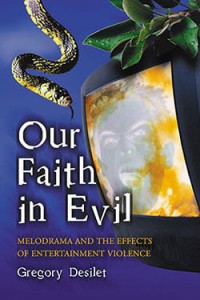
Our Faith in Evil
Melodrama and the Effects of Entertainment Violence


 (0 vote)
Average rating:
| 0 | rating |  = We can do without = We can do without |
| 0 | rating |  = Good book = Good book |
| 0 | rating |  = Excellent book = Excellent book |
| 0 | rating |  = Unique / a reference = Unique / a reference |
Your rating: -
Book Presentation:
Is violence in American cinema a reflection of life? Or does life imitate the violence people see in cinema? One of the pressing questions in today’s society is whether fictional portrayals of violence have social or psychological consequences. Studies have concluded with both “yes” and “no” verdicts. Is America a culture of violence? Why does violence, horror and melodrama appeal to people? This book explores these issues with primary focus on entertainment, especially film, through lenses of the media, the consumer, and the cultural backdrop. The film A Clockwork Orange allegedly spawned so much violence in the United Kingdom that director Stanley Kubrick was rumored to have fled with his family to avoid a death threat. From that classic case, the author takes readers through a study of media and violence that examines the structure of horror, the origin and nature of evil, the Greek mythic tradition, melodrama and catharsis, fairy tales, comic books, video games and real horror. In part two the author offers case studies in several genres: westerns, multi-melodrama (The Silence of the Lambs), slasher films, psycho drama, serials such as Star Wars and Harry Potter, apocalyptic melodrama, modern and postmodern noir, creature features and religious melodrama. In-text citations are included, and two notes expand on a couple of issues in the text—the perspectives of Plato and Aristotle on the effects of tragic drama, and discussion of differences of opinion relating to methodological approach.
About the Author:
Gregory Desilet has spent more than four decades researching and writing on communication and rhetorical theory, language philosophy, and various media and cultural phenomena as these relate to conflict, violence, and community formation. He lives in Santa Fe, New Mexico.
> From the same author:
> On a related topic:
Images of Unrest (2026)
Documentary Film and Political Violence
by Nikolaj Lübecker and Daniele Rugo
Subject: Sociology
The Body Onscreen in the Digital Age (2021)
Essays on Voyeurism, Violence and Power
Dir. Susan Flynn
Subject: Sociology
New Brutality Film (2005)
Race and Affect in Contemporary Hollywood Cinema
by Paul Gormley
Subject: Sociology
Tattoos, Desire and Violence (2005)
Marks of Resistance in Literature, Film and Television
by Karin Beeler
Subject: Sociology

Reel Knockouts (2001)
Violent Women in the Movies
Dir. Martha McCaughey and Neal King
Subject: Sociology
Bound and Gagged (1998)
Pornography and the Politics of Fantasy in America
by Laura Kipnis
Subject: Sociology
 Back
Back

