


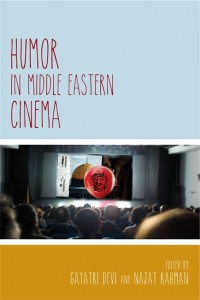
Humor in Middle Eastern Cinema
Edited by Gayatri Devi and Najat Rahman


 (0 vote)
Average rating:
| 0 | rating |  = We can do without = We can do without |
| 0 | rating |  = Good book = Good book |
| 0 | rating |  = Excellent book = Excellent book |
| 0 | rating |  = Unique / a reference = Unique / a reference |
Your rating: -
Book Presentation:
While Middle Eastern culture does not tend to be associated with laughter and levity in the global imagination, humor―often satirical―has long been a staple of mainstream Arabic film. In Humor in Middle Eastern Cinema, editors Gayatri Devi and Najat Rahman shed light on this tradition, as well as humor and laughter motivated by other intent―including parody, irony, the absurd, burlesque, and dark comedy. Contributors trace the proliferation of humor in contemporary Middle Eastern cinema in the works of individual directors and from the perspectives of genre, national cinemas, and diasporic cinema.
Humor in Middle Eastern Cinema explores what humor theorists have identified as an "emancipatory," "liberatory," even "revolutionary" function to humor. Among the questions contributors ask are: How does Middle Eastern cinema and media highlight the stakes and place of humor in art and in life? What is its relation to the political? Can humor in cinematic art be emancipatory? What are its limits for its intervention or transformation? Contributors examine the region's masterful auteurs, such as Abbas Kiarostami, Youssef Chahine, and Elia Suleiman and cover a range of cinematic settings, including Egypt, Iran, Israel, Lebanon, Palestine, Syria, Tunisia, and Turkey. They also trace diasporic issues in the distinctive cinema of India and Pakistan.
This insightful collection will introduce readers to a variety of contemporary Middle Eastern cinema that has attracted little critical notice. Scholars of cinema and media studies as well as Middle Eastern cultural history will appreciate this introduction to a complex and fascinating cinema.
About the authors:
Gayatri Devi is assistant professor of English at Lock Haven University, Pennsylvania. Najat Rahman is associate professor of comparative literature at the University of Montreal. She is author of Literary Disinheritance: The Writing of Home in the Work of Mahmoud Darwish and Assia Djebar. She is co-editor of Mahmoud Darwish, Exile's Poet: Critical Essays.
> On a related topic:
An Atonal Cinema (2025)
Resistance, Counterpoint and Dialogue in Transnational Palestine
Subject: Countries > Middle East
Women's New Cinema in Contemporary Turkey (2025)
As If We Were Free, As If a Beautiful Life Were Possible
Subject: Countries > Middle East
Transnational Arab Stardom (2025)
Glamour, Performance and Politics
Dir. Kaya Davies Hayon and Stefanie Van de Peer
Subject: Countries > Middle East
Understanding the Public Sector in Egyptian Cinema (2024)
A State Venture
Subject: Countries > Middle East
Reorienting the Middle East (2024)
Film and Digital Media Where the Persian Gulf, Arabian Sea, and Indian Ocean Meet
Dir. Dale Hudson and Alia Yunis
Subject: Countries > Middle East
Cinema in the Arab World (2024)
New Histories, New Approaches
Dir. Ifdal Elsaket, Daniel Biltereyst and Philippe Meers
Subject: Countries > Middle East
Crisis Cinema in the Middle East (2024)
Creativity and Constraint in Iran and the Arab World
Subject: Countries > Middle East
Reel Gender (2024)
Palestinian and Israeli Cinema
Dir. Sa'ed Atshan and Katharina Galor
Subject: Countries > Middle East
 Back
Back

