


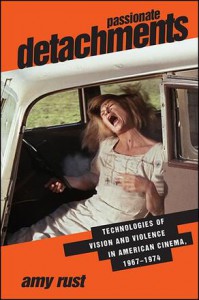
Passionate Detachments
Technologies of Vision and Violence in American Cinema, 1967-1974
by Amy Rust


 (0 vote)
Average rating:
| 0 | rating |  = We can do without = We can do without |
| 0 | rating |  = Good book = Good book |
| 0 | rating |  = Excellent book = Excellent book |
| 0 | rating |  = Unique / a reference = Unique / a reference |
Your rating: -
Book Presentation:
Investigates the cultural value of film violence.
Passionate Detachments investigates the rise of graphic violence in American films of the late 1960s and early 1970s and the popular aesthetics and critical responses this violence inspired. Amy Rust examines four technologies adopted by commercial American cinema after the fall of the Hollywood Production Code: multiple-camera montage, squibs (small explosive devices) and artificial blood, freeze-frames, and zooms. Approaching these technologies as figures, as opposed to mere tools, Rust traces the encounters they mediate between perception (what one sees, hears, and feels) and representation (how those sights, sounds, and feelings make meaning). These technologies, she argues, lend shape to film violence while organizing viewers' on- and off-screen relationships to it.
The result proves meaningful for an era self-consciously and perilously preoccupied with bloodshed. The post-Code period found Americans across the political spectrum demanding visual—and increasingly violent—demonstrations of presumably "authentic" realities. Corroborating fantasies of authenticity from military to counterculture, these technologies challenge them as well, pointing, however unwittingly, to the violently classed, gendered, and racialized blind spots such fantasies harbor. More broadly, the technologies answer concerns that films control violence too much or too little. Offering neither mere discourse nor mere thrills, they recover sense and sensation for all, not some, or even most, depictions of bloodshed. As figures, the devices also remediate vision and violence for film theory, which exhibits distrust for each in spite of the complexities phenomenology and psychoanalysis have brought to cinematic perception and pleasure.
About the Author:
Amy Rust is Assistant Professor in the Department of Humanities and Cultural Studies at the University of South Florida.
See the publisher website: State University of New York Press
> On a related topic:
Hollywood Riots (2016)
Violent Crowds and Progressive Politics in American Film
by Doug Dibbern
Subject: Sociology
Screening the Crisis (2024)
US Cinema and Social Change in the Wake of the 2008 Crash
Dir. Hilaria Loyo
Subject: Sociology
The Precarious in the Cinemas of the Americas (2018)
Dir. Constanza Burucúa and Carolina Sitnisky
Subject: Sociology

The Silent Appalachian (2017)
Wordless Mountaineers in Fiction, Film and Television
Subject: Sociology
Film and the Working Class (2015)
The Feature Film in British and American Society
by Peter Stead
Subject: Sociology
Native Americans on Film (2013)
Conversations, Teaching, and Theory
Dir. M. Elise Marubbio and Eric L. Buffalohead
Subject: Sociology
 Back
Back

