

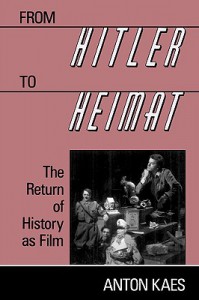
From Hitler to Heimat
The Return of History as Film
de Anton Kaes


 (0 vote)
Moyenne des votes :
| 0 | vote |  = On peut s'en passer = On peut s'en passer |
| 0 | vote |  = Bon livre = Bon livre |
| 0 | vote |  = Excellent livre = Excellent livre |
| 0 | vote |  = Unique / une référence = Unique / une référence |
Votre vote : -
Description de l'ouvrage:
West German filmmakers have tried to repeatedly over the past half-century to come to terms with Germany's stigmatized history. How can Hitler and the Holocaust, how can the complicity and shame of the average German be narrated and visualized? How can Auschwitz be reconstructed? Anton Kaes argues that a major shift in German attitudes occurred in the mid-1970s--a shift best illustrated in films of the New German Cinema, which have focused less on guilt and atonement than on personal memory and yearning for national identity.
To support his claim, Kaes devotes a chapter to each of five complex and celebrated films of the modern German era: Hans J rgen Syberberg's Hitler, a Film from Germany, a provocative restaging of German history in postmodern tableaux; The Marriage of Maria Braun, the personal and political reflection on postwar Germany with which Rainer Werner Fassbinder first caught the attention of American and European audiences; Helma Sanders-Brahms's feminist and autobiographical film Germany, Pale Mother, relating the unexplored role of German women during and after the war; Alexander Kluge's The Patriot, a self-reflexive collage of verbal and visual quotations from the entire course of the German past; and, finally, Edgar Reitz's Heimat, a 16-hour epic rendering of German history from 1918 to the present from the perspective of everyday life in the provinces.
Despite radical differences in style and form, these films are all concerned with memory, representation, and the dialogue between past and present Kaes draws from a variety of disciplines, interweaving textual interpretation, cultural history, and current theory to create a dynamic approach to highly complex and multi-voiced films. His book will engage readers interested in postwar German history, politics, and culture; in film and media studies; and in the interplay of history, memory, and film.
> Du même auteur :

The Promise of Cinema (2016)
German Film Theory, 1907–1933
Dir. Anton Kaes, Nicholas Baer et Michael Cowan
Sujet : Theory

> Sur un thème proche :
Projecting History (2002)
German Nonfiction Cinema 1967-2000
New German Cinema and Its Global Contexts (2025)
A Transnational Art Cinema
Dir. Marco Abel et Jaimey Fisher

Charting Asian German Film History (2025)
Imagination, Collaboration, and Diasporic Representation
Dir. Qinna Qinna Shen, Zach Ramon Fitzpatrick et Qingyang Freya Zhou

Neubau Atmospheres (2025)
East German Cultural Remediations of Modernist Architecture
Transnational German Film at the End of Neoliberalism (2024)
Radical Aesthetics, Radical Politics
Dir. Claudia Breger et Olivia Landry
Cinematically Transmitted Disease (2024)
Eugenics and Film in Weimar and Nazi Germany
 Retour