


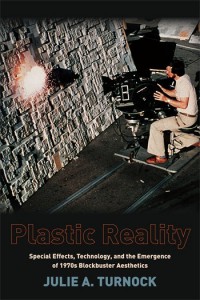
Plastic Reality
Special Effects, Technology, and the Emergence of 1970s Blockbuster Aesthetics


 (0 vote)
Moyenne des votes :
| 0 | vote |  = On peut s'en passer = On peut s'en passer |
| 0 | vote |  = Bon livre = Bon livre |
| 0 | vote |  = Excellent livre = Excellent livre |
| 0 | vote |  = Unique / une référence = Unique / une référence |
Votre vote : -
Description de l'ouvrage:
Julie A. Turnock tracks the use and evolution of special effects in 1970s filmmaking, a development as revolutionary to film as the form's transition to sound in the 1920s. Beginning with the classical studio era's early approaches to special effects, she follows the industry's slow build toward the significant advances of the late 1960s and early 1970s, which set the stage for the groundbreaking achievements of 1977.
Turnock analyzes the far-reaching impact of the convincing, absorbing, and seemingly unlimited fantasy environments of that year's iconic films, dedicating a major section of her book to the unparalleled innovations of Star Wars and Close Encounters of the Third Kind. She then traces these films' technological, cultural, and aesthetic influence into the 1980s in the deployment of optical special effects as well as the "not-too-realistic" and hyper-realistic techniques of traditional stop motion and Showscan. She concludes with a critique of special effects practices in the 2000s and their implications for the future of filmmaking and the production and experience of other visual media.
À propos de l'auteur :
Julie A. Turnock is assistant professor of media and cinema studies at the University of Illinois, Urbana–Champaign.
Revue de Presse:
With consummate research and clear explanations, Turnock shows how the special effects revolution actually took place before CGI and how the way the blockbusters of the late sixties and seventies, Star Wars and Close Encounters of the Third Kind, introduced new conceptions of cinema's relation to reality and fantasy—and how it relates to the cinema of today. Tom Gunning, author of Fritz Lang: Allegories of Vision and Modernity
Turnock's contribution is rich at multiple levels... Plastic Reality well merits pride of place within the burgeoning area of special effects study. Film Quarterly
Voir le site internet de l'éditeur Columbia University Press
> Du même auteur :
The Empire of Effects (2023)
Industrial Light and Magic and the Rendering of Realism
Sujet : Studio > Industrial Light and Magic
> Sur un thème proche :
Hidden in Plain Sight (2015)
An Archaeology of Magic and the Cinema
Sujet : Technique > Special effects
Invisible Visual Effects (2026)
The Hidden Magic of Film VFX
de Jin Zhi
Sujet : Technique > Special effects
Making Monsters (2025)
Inside Stories from the Creators of Hollywood's Most Iconic Creatures
de Howard Berger et Marshall Julius
Sujet : Technique > Special effects
The VES Handbook of Visual Effects (2025)
Industry Standard VFX Practices and Procedures
Dir. Jeffrey A. Okun, Susan Zwerman et Susan Thurmond O'Neal
Sujet : Technique > Special effects
Digital Compositing for Film and Video (2024)
Production Workflows and Techniques
de Steve Wright
Sujet : Technique > Special effects
Special Effects on the Screen (2022)
Faking the View from Méliès to Motion Capture
Dir. Martin Lefebvre et Marc Furstenau
Sujet : Technique > Special effects
 Retour

