


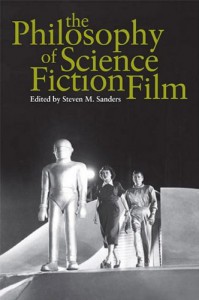
The Philosophy of Science Fiction Film
Sous la direction de Steven M. Sanders


 (0 vote)
Moyenne des votes :
| 0 | vote |  = On peut s'en passer |
| 0 | vote |  = Bon livre |
| 0 | vote |  = Excellent livre |
| 0 | vote |  = Unique / une référence |
Votre vote : -
Description de l'ouvrage:
From Metropolis (1927) to The Matrix (1999), science fiction films have captivated audiences worldwide for more than seven decades. In recent years, philosophers have turned their eyes towards the same screen, attracted by the salient storylines, conflicts, and themes nestled amongst the new technologically and time altered landscapes. They have discovered that science fiction films offer more than an imaginative escape from the real world -- they also provide a rich medium through which to address issues of identity, consciousness, agency, space, time, causality, and other categories of experience.
Editor Steven M. Sanders argues that the appeal of science fiction films has led to a proliferation of misguided interpretations and weak arguments in the film criticism of the genre. The Philosophy of Science Fiction Film aims to restore integrity to science fiction film criticism by penetrating the surface of the films in order to unearth the presupposed philosophical arguments, ethical perspectives, and metaphysical views that underlie them.
The first section, "Enigmas of Identity and Agency" treats issues of identity, moral agency, and the meaning of being human in films such as Total Recall (1990), Blade Runner (1982), and Invasion of the Body Snatchers (1956). In the second part, "Extraterrestrial Visitation, Time Travel, and Artificial Intelligence," contributors dissect such films as 2001: A Space Odyssey, The Terminator, and The Day the Earth Stood Still to examine the implications of new technology on civilization, the paradoxes surrounding artificial intelligence, and the possibilities offered by time travel. The final section, "Braver New World: Science Fiction Futurism" looks at Metropolis, The Matrix, Alphaville, and screen adaptations of Orwell's 1984 to analyze our visions of the future and humans' role in it.
The Philosophy of Science Fiction Film highlights the interconnectivity of the science fiction genre and philosophy. The contributing philosophers, film critics, and scholars highlight the relationship between philosophy and science fiction film, offering original philosophical perspectives on the logical possibility and paradoxes of personal identity, the nature of consciousness and artificial intelligence, time travel, encounters with extraterrestrials, and transformations of the future.
Voir le site internet de l'éditeur University Press of Kentucky
> Du même auteur :

Hitchcock's Moral Gaze (2018)
Dir. R. Barton Palmer, Homer B. Pettey et Steven M. Sanders
Sujet : Director > Alfred Hitchcock

> Sur un thème proche :


Science Fiction and Political Philosophy (2022)
From Bacon to Black Mirror
Dir. Timothy McCranor et Steven Michels
Sujet : Genre > Science Fiction


McLuhan's Galaxies (2019)
Science Fiction Film Aesthetics in Light of Marshall McLuhan's Thought
Sujet : Genre > Science Fiction


Reality Unbound (2017)
New Departures in Science Fiction Cinema
de Aidan Power, Delia González de Reufels, Rasmus Greiner et Winfried Pauleit
Sujet : Genre > Science Fiction
The Monomyth in American Science Fiction Films (2014)
28 Visions of the Hero's Journey
Sujet : Genre > Science Fiction

Terminal identity (1993)
the virtual subject in postmodern science fiction
Sujet : Genre > Science Fiction


Strangelove Country (2025)
Science Fiction, Filmosophy, and the Kubrickian Consciousness
Sujet : Director > Stanley Kubrick
 Retour


