


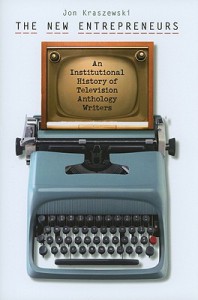
The New Entrepreneurs
An Institutional History of Television Anthology Writers


 (0 vote)
Average rating:
| 0 | rating |  = We can do without = We can do without |
| 0 | rating |  = Good book = Good book |
| 0 | rating |  = Excellent book = Excellent book |
| 0 | rating |  = Unique / a reference = Unique / a reference |
Your rating: -
Book Presentation:
How television writers thwarted the constraints of corporate culture in the 1950s and flourished
According to the sociologist C. Wright Mills in his 1951 book, White Collar: The American Middle Classes, the "new entrepreneur" was a lone wolf able to succeed in post-World War II corporate America by elusively meandering through various institutions. During this time, anthology writers such as Rod Serling, Reginald Rose, and Paddy Chayefsky achieved a level of creativity that has rarely been equaled on television since. Yet despite their success, anthology writers still needed to evade the constraints and censorship of 50s television in order to stay true to their creative powers and political visions. Thus they worked as new entrepreneurs who adapted their more controversial scripts for the Hollywood, Broadway, and book publishing industries. Even after the television networks cancelled their prestigious anthology series at the end of the 50s, the most resilient writers were able to redefine what it meant to be entrepreneurs by launching cutting-edge shows such as The Twilight Zone and The Defenders that are still popular today. The New Entrepreneurs includes detailed textual analysis of legendary, sometimes hard-to-find, television anthology scripts that have received only cursory glances in television history until now.
About the Author:
JON KRASZEWSKI is an assistant professor in the Department of Communication at Seton Hall University.
> On a related topic:
Leslie Stevens Goes to Hollywood (2020)
Daystar Productions, Kate Manx and the Making of Private Property
by Dore Page
Subject: Director > Leslie Stevens
Rem Koolhaas as Scriptwriter (2025)
OMA Architecture Script for West Berlin
Subject: Technique > Scriptwriting
The Palgrave Handbook of Screenwriting Studies (2023)
Dir. Rosamund Davies, Paolo Russo and Claus Tieber
Subject: Technique > Scriptwriting
On Story (2016)
Screenwriters and Filmmakers on Their Iconic Films
Dir. Barbara Morgan and Maya Perez
Subject: Technique > Scriptwriting
Backstory 5 (2009)
Interviews with Screenwriters of the 1990s
Dir. Patrick McGilligan
Subject: Technique > Scriptwriting
Backstory 4 (2006)
Interviews with Screenwriters of the 1970s and 1980s
Subject: Technique > Scriptwriting
Story and Character (2004)
Interviews With British Screenwriters
Dir. Alistair Owen
Subject: Technique > Scriptwriting
 Back
Back

