

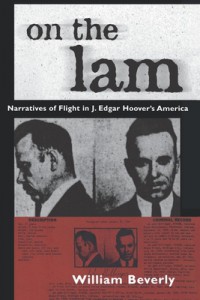
On the Lam
Narratives of Flight in J. Edgar Hoover's America


 (0 vote)
Average rating:
| 0 | rating |  = We can do without = We can do without |
| 0 | rating |  = Good book = Good book |
| 0 | rating |  = Excellent book = Excellent book |
| 0 | rating |  = Unique / a reference = Unique / a reference |
Your rating: -
Book Presentation:
The fugitive is the sinister hero of many a novel (Light in August, Beloved), the luminary in a cluster of motion pictures and in other popular entertainment (Butch Cassidy and the Sundance Kid, Bonnie and Clyde, The Fugitive, Thelma and Louise), and a headliner for the daily news (O. J. Simpson, Osama bin Laden). Yet, although a paradigm and symbol, seldom has the fugitive figure been the focus of literary or cultural discussion.
Correcting that oversight, this book maps changing landscapes of criminal flight in American texts by focusing on the twenty years between 1932 and 1952, the period when the codes of J. Edgar Hoover’s FBI first prevailed. It was the time that policing was modernized and reconfigured, a time when law enforcement fought to redeem itself from the corruption and compromise of Prohibition.
The young Hoover was the star of this rehabilitation. His administrative innovations were matched only by his tireless effort to shape public sentiment about crime. His complex system employed information and communication technology as a way to overcome the obstacles posed by disparate jurisdictions, regional difference, and the remoteness of America’s hinterlands. As he united these regions in a coherent body, a national whole, he transformed the geography of American crime.
Within this cultural context, On the Lam aligns fugitive slave narratives, classics of noir, works by Richard Wright and Ralph Ellison, and narratives of the deadly contest between Hoover’s FBI and the charismatic midwestern bandit, John Dillinger. These bear witness not only to a project of law and order but also to the conception and deployment of a coordination and surveillance network that thrust policing power far beyond the presence of the officer.
Even as the fugitives depicted in these works seek the wilderness beyond the policed frontier, On the Lam finds their tales to be an exacting gauge of America’s final transit into modernity.
About the Author:
William Beverly teaches American literature and writing at Trinity University in Washington, DC. His fiction has appeared in The Mississippi Review and Indy Men's Magazine. He is author of the award-winning Dodgers: A Novel.
> On a related topic:

Film as an Art of Society (2025)
Aesthetic Innovations and Social Relations
Dir. Lutz Hieber and Rainer Winter
Subject: Sociology
Working Women on Screen (2025)
Paid Labour and Fourth Wave Feminism
Dir. Ellie Tomsett, Nathalie Weidhase and Poppy Wilde
Subject: Sociology

Screening the Crisis (2024)
US Cinema and Social Change in the Wake of the 2008 Crash
Dir. Hilaria Loyo
Subject: Sociology
Film X Autochthonous Struggles Today (2024)
by Nicole Brenez, Jonathan Larcher, Alo Paistik and Skaya Siku
Subject: Sociology
 Back
Back